Commercial spray foam insulation delivers a measurable combination of thermal performance, air sealing, and moisture resistance that directly reduces energy consumption in commercial buildings. In Molino, Florida, where Escambia County sits in IECC Climate Zone 2A (hot and humid), these properties matter more than in most markets. According to the U.S. Department of Energy, heating and cooling account for 50 to 70% of the energy used in the average American building, and inadequate insulation and air leakage are the leading causes of energy waste. Spray foam insulation addresses both issues simultaneously by expanding into gaps, cracks, and hard-to-reach spaces to form a continuous thermal and air barrier. The result is lower utility costs, improved occupant comfort, better indoor air quality, and long-term building protection against humidity-driven moisture damage. The right insulation strategy depends on your building type, existing conditions, and budget, but spray foam consistently offers the strongest return on investment for commercial properties in hot-humid climates like Molino.
TL;DR
- Spray foam insulation simultaneously seals air leaks and provides high R-value thermal resistance, making it uniquely effective for commercial buildings in hot-humid climates.
- Escambia County falls within IECC Climate Zone 2A, where Florida’s energy code requires specific R-values for ceilings, walls, and floors that spray foam can meet with less material thickness than alternatives.
- Closed-cell spray foam delivers approximately R-6.0 per inch and acts as a moisture barrier, while open-cell foam provides about R-3.5 per inch with sound-absorbing qualities.
- Oak Ridge National Laboratory research demonstrates that spray foam retrofit applications reduced air leakage from 10-15 ACH to as low as 4.21 ACH, drastically cutting energy waste.
- The EPA estimates that proper air sealing combined with insulation can reduce heating and cooling costs by up to 20%.
- Spray foam insulation performs effectively for 20 to 30 years or longer when properly installed, outlasting many traditional alternatives.
- The material resists mold, pests, and water intrusion, which is especially important in Florida’s humid subtropical environment.
- Selecting a qualified, certified installer is the single most important factor in achieving the expected performance and longevity from spray foam.
Molino’s Climate Makes Insulation a Priority, Not an Option
Molino, located in Escambia County in Florida’s western Panhandle, experiences a humid subtropical climate. Summers bring sustained high temperatures and elevated humidity, while winters remain mild but still require heating during cold snaps. According to the American Society for Heating, Refrigerating and Air-Conditioning Engineers, Florida’s energy code divides the state into two IECC climate zones: Zone 1A (very hot and humid, covering the southernmost counties) and Zone 2A (hot and humid, covering the majority of the state, including Escambia County). This classification carries direct implications for commercial insulation requirements.
The Florida Energy Conservation Code (FECC), which adopts the 2018 IECC and ASHRAE 90.1-2016 as its basis, sets prescriptive R-value requirements for commercial building envelopes. In Climate Zone 2A, these minimums include specific R-values for ceilings, wood-frame and mass walls, and floors above unconditioned spaces. Meeting and exceeding these minimums with spray foam allows commercial property owners in Molino to reduce HVAC loads significantly and protect building materials from the constant moisture pressure that defines the Gulf Coast environment. Following a commercial building insulation guide can help property owners understand these requirements and maximize long-term energy savings.
| Climate Zone | Classification | Ceiling R-Value | Wood Frame Wall | Floor Over Unconditioned Space |
|---|---|---|---|---|
| Zone 1A | Very Hot-Humid | R-30 | R-13 | R-13 |
| Zone 2A (Molino) | Hot-Humid | R-38 | R-13 | R-19 |
| Zone 3 | Warm | R-38 | R-20 | R-30 |
How Spray Foam Outperforms Traditional Insulation in Commercial Applications
Not all insulation materials perform equally in a hot-humid climate. Fiberglass batts, cellulose, and rigid foam boards each have strengths, but none combine the thermal resistance, air sealing, and moisture control properties that spray foam offers in a single application. The DOE’s Insulation Fact Sheet explains that thermal bridging through structural framing, gaps around penetrations, and compressed or poorly fitted insulation can reduce the effective R-value of traditional materials by a significant margin. Spray foam expands to fill cavities, conforms to irregular surfaces, and adheres to framing members, eliminating the voids and compression issues that undermine other insulation types.
| Insulation Type | R-Value Per Inch | Air Sealing | Moisture Resistance | Best Commercial Use |
|---|---|---|---|---|
| Fiberglass Batts | R-3.1 to R-4.3 | Poor | Low | Standard wall cavities |
| Cellulose (Blown-In) | R-3.1 to R-3.8 | Moderate | Low | Enclosed existing walls |
| Rigid Foam Board | R-3.8 to R-6.5 | Moderate | Moderate | Continuous exterior sheathing |
| Closed-Cell Spray Foam | R-5.6 to R-7.0 | Excellent | High | Walls, roofs, crawlspaces, and metal buildings |
| Open-Cell Spray Foam | R-3.5 to R-3.7 | Excellent | Low | Interior walls, sound-dampening |
Closed-cell spray foam is particularly effective for commercial buildings in Molino because its dense cell structure resists water vapor transmission. In a climate where outdoor humidity regularly exceeds 70%, preventing moisture from penetrating wall and roof assemblies is essential to avoid condensation, mold growth, and structural degradation. Open-cell spray foam, while offering a lower R-value per inch, provides superior sound absorption and fills cavities effectively at a lower installed cost, making it a practical option for interior partitions and noise-sensitive commercial spaces. These advantages make commercial spray foam insulation in Molino, FL, a valuable solution for long-term building performance.
Air Sealing: The Hidden Energy Savings in Your Building Envelope
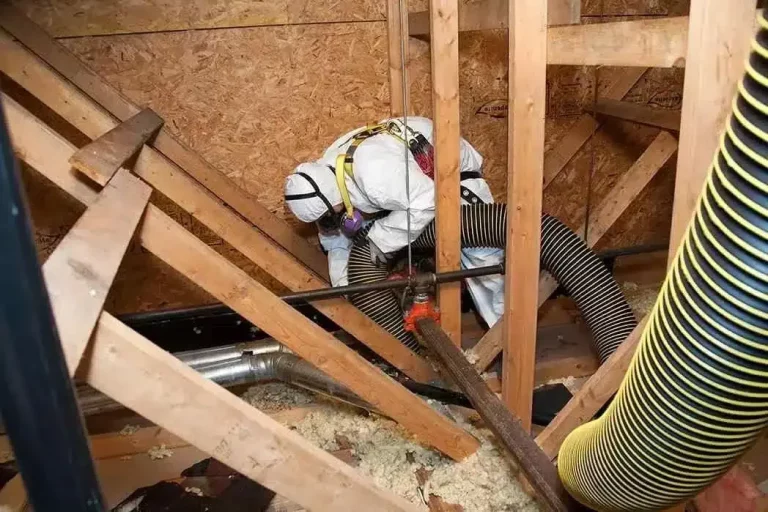
One of the most overlooked opportunities in commercial building performance is air leakage. Gaps around window frames, door assemblies, plumbing penetrations, electrical conduit entries, and wall-to-ceiling intersections allow conditioned air to escape and unconditioned outdoor air to infiltrate. In commercial buildings with ductwork running through unconditioned attics or crawlspaces, these leaks force HVAC systems to work harder to maintain set temperatures.
ORNL research on spray foam retrofits in mixed-humid climates documented dramatic improvements in building tightness. In one study, spray foam application reduced air changes per hour from a baseline of 10-15 ACH down to as low as 4.21 ACH, a reduction that directly correlates to lower energy consumption and better indoor temperature consistency. The EPA confirms that sealing air leaks combined with proper insulation is one of the most cost-effective ways to improve building energy efficiency, reducing heating and cooling costs by up to 20%.
For Molino commercial properties, this air sealing benefit is compounded by the humidity differential between air-conditioned interiors and the hot, moist exterior. Every unsealed gap not only wastes energy but also allows humid air to enter the building envelope, where it can condense on cooler surfaces and initiate moisture-related damage that is costly to remediate.
Closed-Cell vs. Open-Cell: Choosing the Right Spray Foam for Your Building
The choice between closed-cell and open-cell spray foam depends on the specific application, budget, and performance priorities of your commercial project. Both types are applied as a liquid that expands and cures in place, but they differ substantially in density, R-value, and moisture resistance.
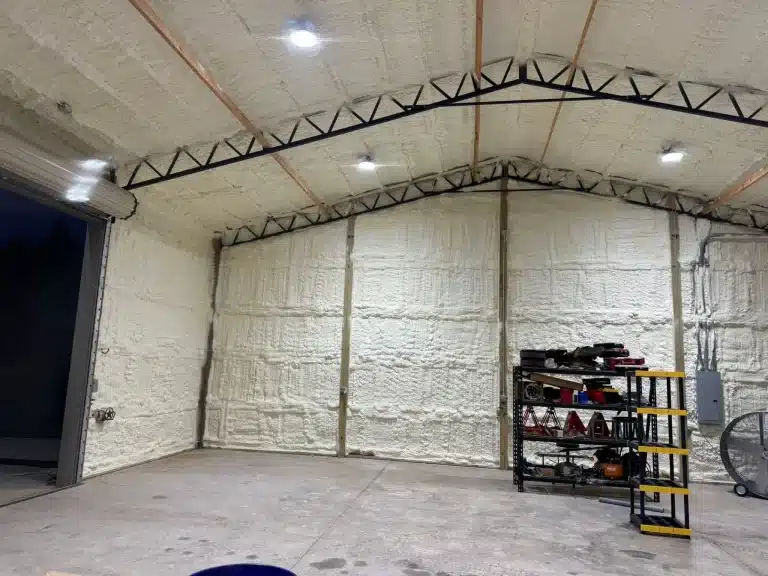
Closed-cell spray foam delivers approximately R-6.0 per inch and forms a rigid, dense material that resists water penetration. It adds structural rigidity to wall and roof assemblies, making it well-suited for metal building insulation, flat roof systems, and below-grade applications such as crawlspaces and basement walls. In Molino’s humid climate, closed-cell foam is often the preferred choice for exterior building envelopes where moisture resistance is a priority.
Open-cell spray foam provides approximately R-3.5 per inch and has a softer, spongy texture. It expands more during application, which helps it fill irregular cavities thoroughly. Open-cell foam should not be used in direct contact with water or in below-grade applications, but it excels as interior wall insulation where sound attenuation is valuable, such as in office partitions, conference rooms, and multi-tenant commercial spaces.
A common commercial strategy combines both types in a hybrid application. A thin layer of closed-cell foam is applied first to serve as an air and moisture barrier, then open-cell foam or another insulation material is layered on top to reach the target total R-value. This approach, sometimes called “flash and fill,” achieves high thermal performance at a lower overall cost than using closed-cell foam alone for the full assembly thickness.
Long-Term Durability and Building Protection
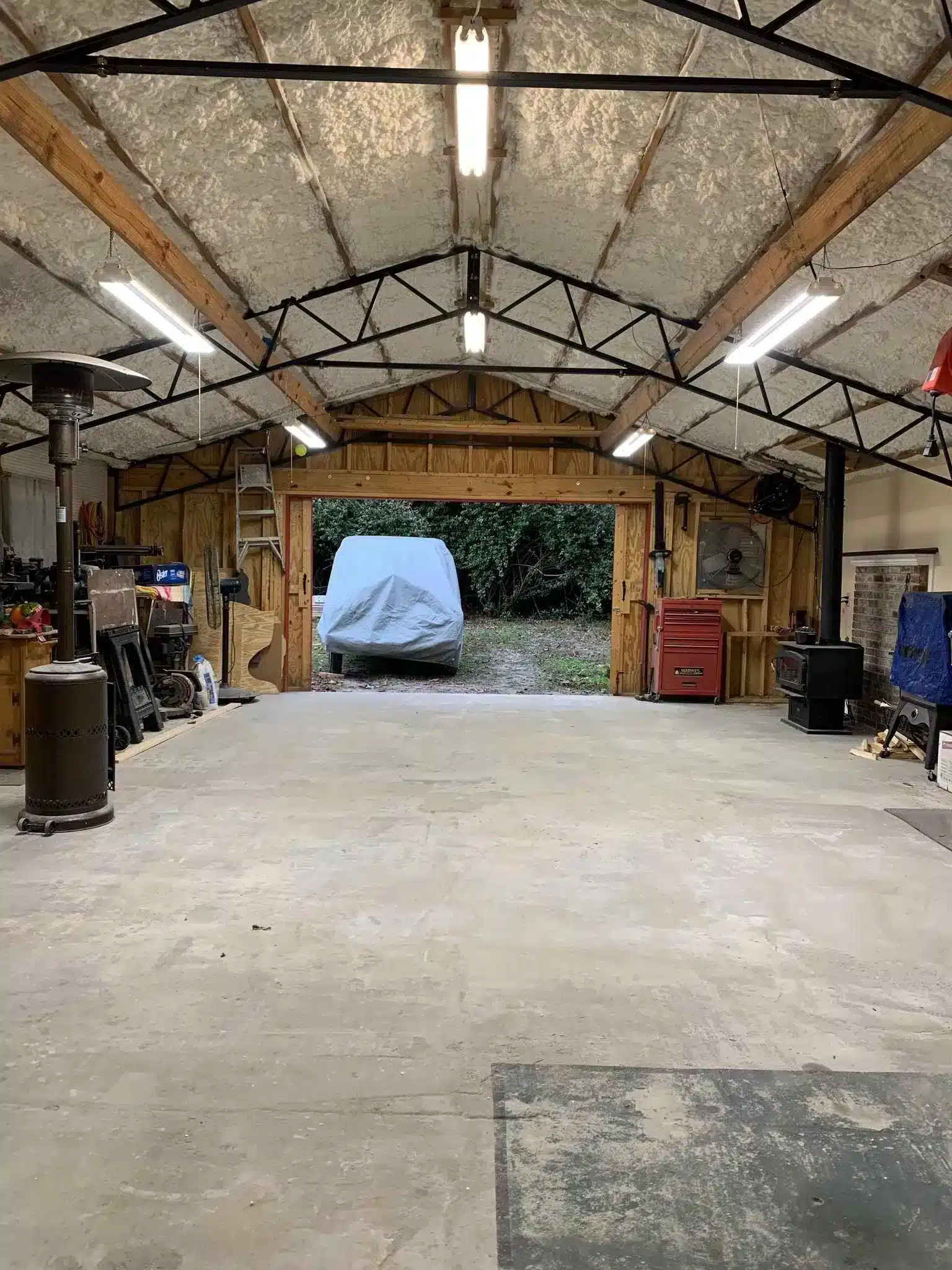
One of the strongest arguments for commercial spray foam insulation in Molino is its durability. When properly installed, spray foam insulation maintains its R-value and air-sealing properties for 20 to 30 years, and in many cases it can perform effectively for the entire service life of the building. Unlike fiberglass batts that can settle, sag, or be displaced by moisture and pests, spray foam adheres permanently to the substrate and does not degrade under normal conditions.
In Florida’s humid environment, moisture management is a constant concern for commercial building owners. Closed-cell spray foam acts as both a thermal insulator and a vapor retarder, limiting the amount of moisture that can diffuse into wall and roof assemblies. According to the DOE, 70 to 90% of the moisture that passes through the building envelope arrives via air leakage rather than diffusion. Because spray foam seals the air pathways that carry moisture, it addresses the primary mechanism for moisture intrusion in addition to providing insulation.
This moisture resistance also translates to mold prevention. By keeping wall cavities and roof assemblies dry, spray foam reduces the conditions that support mold and mildew growth, protecting both the building structure and the health of occupants. For commercial properties where indoor air quality affects employee productivity and customer experience, this benefit has direct operational value.
Which Commercial Buildings Benefit Most from Spray Foam in Molino
Different building types in the Molino area have distinct insulation challenges and opportunities. Understanding which applications yield the greatest return helps building owners prioritize their investment.
| Building Type | Primary Challenge | Recommended Foam Type | Key Benefit |
|---|---|---|---|
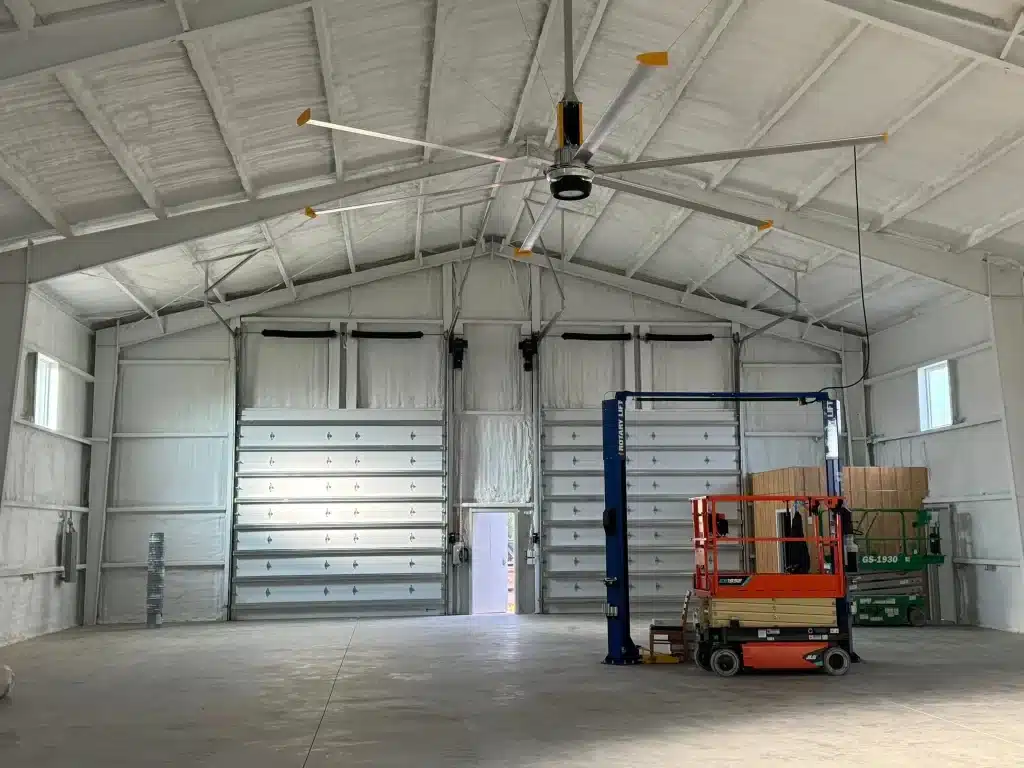
| Metal Warehouses | Thermal bridging, large open spaces | Closed-cell | Eliminates thermal bridging at purlins and girts |
| Office Buildings | Temperature consistency, noise control | Hybrid (closed + open cell) | Comfort and sound reduction |
| Retail Spaces | High HVAC loads, customer comfort | Closed-cell | Reduced cooling costs in the summer months |
| Medical / Healthcare | Indoor air quality, moisture control | Closed-cell | Prevents mold and allergens |
| Agricultural Storage | Temperature and humidity sensitive | Closed-cell | Protects stored goods from moisture |
| Restaurants / Food Service | Condensation, grease, and ventilation | Closed-cell | Manages humidity from cooking operations |
Signs You’ve Found the Right Spray Foam Installer
Choosing a qualified installer is as important as selecting the right insulation material. Poor application can result in uneven coverage, incomplete cavity filling, and foam that does not achieve its rated R-value. Look for these indicators when evaluating a spray foam contractor:
- Detailed scope of work that specifies foam type, thickness targets, and R-value requirements for each area of the building
- Willingness to conduct blower door or infrared testing before and after installation to verify air sealing effectiveness
- Clear safety protocols, including proper ventilation during application, protective equipment, and occupancy guidance
- Documentation of product specifications, including manufacturer data sheets and SDS information for each foam used
- An inspection process that includes checking foam depth at multiple locations to confirm the installation meets the contracted specifications
- Transparent communication about curing times, moisture conditions required for application, and any building preparation needed before the spray date
Request a Commercial Insulation Assessment from Prestige Insulation Solutions LLC
Protecting your commercial building in Molino, FL, starts with the right insulation strategy. Our experienced team at Prestige Insulation Solutions LLC specializes in commercial spray foam insulation installations designed for the hot-humid conditions of the Florida Panhandle. We assess your building envelope, identify air leakage and moisture vulnerability, and recommend the spray foam system that delivers the best performance for your specific application. Whether you need closed-cell foam for a metal warehouse roof or a hybrid solution for an office building retrofit, our professionals apply every project to manufacturer specifications and verify results before leaving your site.
📞 Call us at (850) 429-4969 or email [email protected] to get started.
Frequently Asked Questions
Does spray foam insulation work in Florida’s high humidity?
Yes. Closed-cell spray foam acts as both an air barrier and a moisture barrier, preventing humid outdoor air from penetrating your building envelope and reducing the risk of condensation inside wall and roof assemblies.
How long does commercial spray foam insulation last in Molino?
Properly installed spray foam maintains its thermal and air-sealing performance for 20 to 30 years or more, and in many cases it performs for the entire service life of the commercial building without requiring replacement.
Can spray foam be installed in an existing commercial building?
Yes. Spray foam can be applied to accessible wall cavities, roof assemblies, crawlspaces, and rim joists in existing buildings during retrofits. It fills irregular spaces and conforms to obstructions that make other insulation types difficult to install.
What is the difference between open-cell and closed-cell spray foam for commercial use?
Closed-cell foam provides a higher R-value per inch (approximately R-6.0), resists moisture, and adds structural strength. Open-cell foam offers a lower R-value (approximately R-3.5), costs less, and provides better sound absorption. The right choice depends on the application and building requirements.
Will spray foam insulation help reduce my commercial energy bills?
Yes. By simultaneously insulating and sealing air leaks, spray foam reduces the load on your HVAC system. The EPA estimates that proper sealing and insulation can cut heating and cooling costs by up to 20%, with additional savings from reduced equipment runtime and maintenance.
Sources
- DOE Energy Saver – Types of Insulation – Comprehensive overview of insulation materials, installation methods, advantages, and R-value guidance from the U.S. Department of Energy.
- Oak Ridge National Laboratory – Spray Foam in Accessible Spaces: Best Practices and Case Studies for Retrofit in Mixed-Humid Climates – Detailed research report on spray polyurethane foam performance, air sealing results, and case studies in humid climates.
- U.S. Environmental Protection Agency – Seal and Insulate with ENERGY STAR – EPA guidance on air sealing and insulation for energy efficiency, including cost savings estimates of up to 20% on heating and cooling.
- Rmax – Florida Building Code Insulation Requirements – Breakdown of Florida’s IECC climate zones, commercial insulation R-value requirements, and the Florida Energy Conservation Code framework.
- DOE / Oak Ridge National Laboratory – Insulation Fact Sheet – In-depth reference on R-value ratings, thermal bridging, installation considerations, and insulation performance across all material types.

- What Should You Know Before Hiring Professional Insulation Removal Services in Pensacola, FL? - October 13, 2026
- Everything You Need to Know About Professional Insulation Removal - October 7, 2026
- Which Insulation Upgrades Deliver the Best Long-Term Value in Bagdad, FL? - September 14, 2026