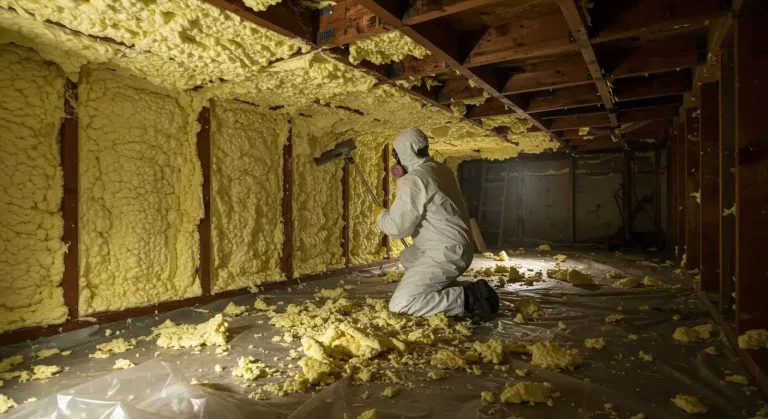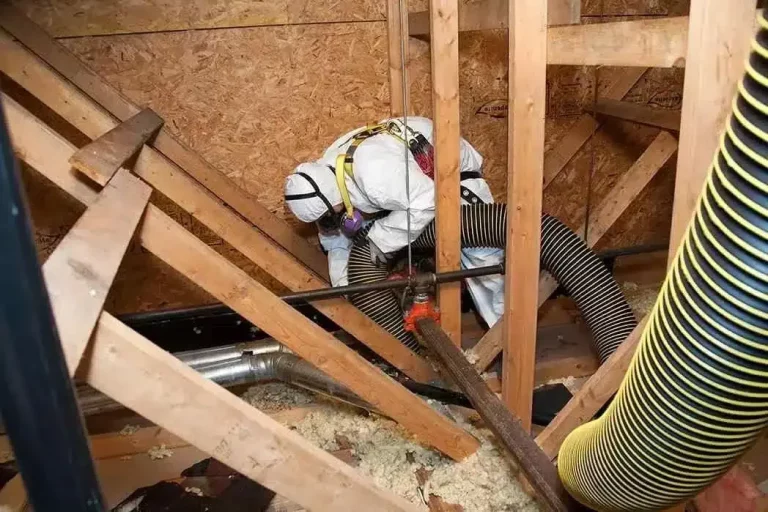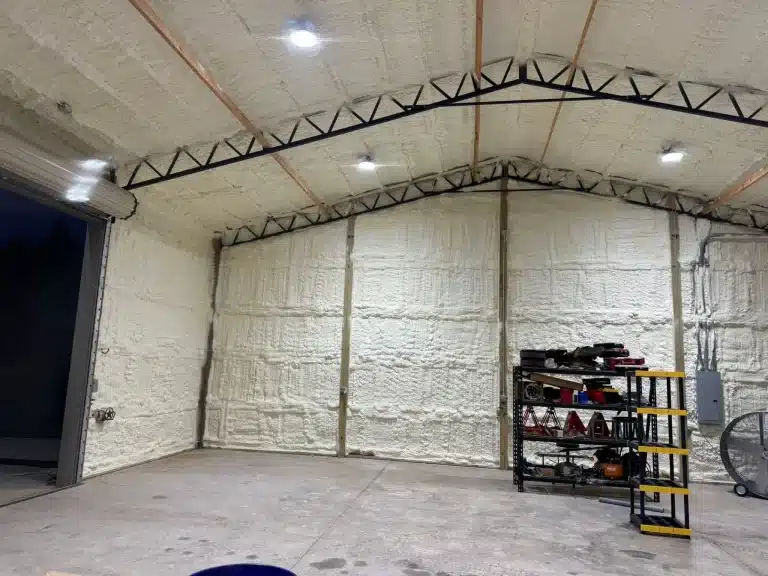
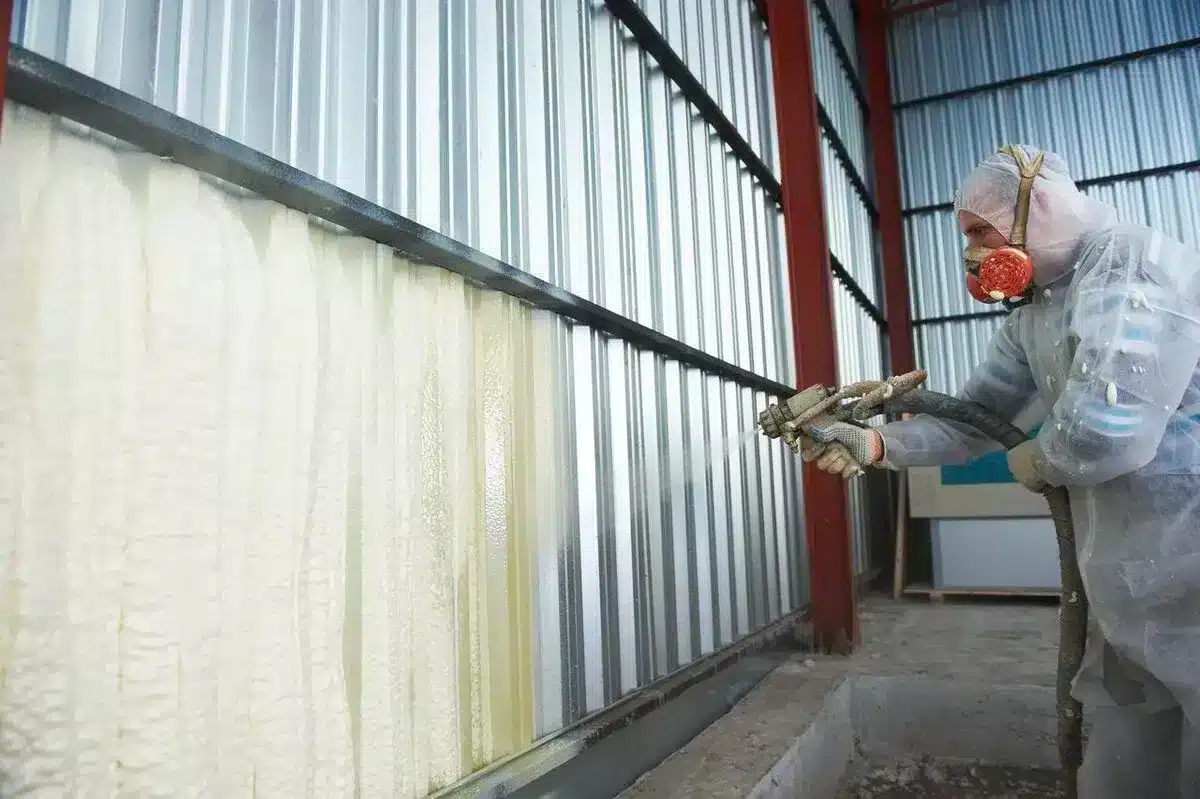
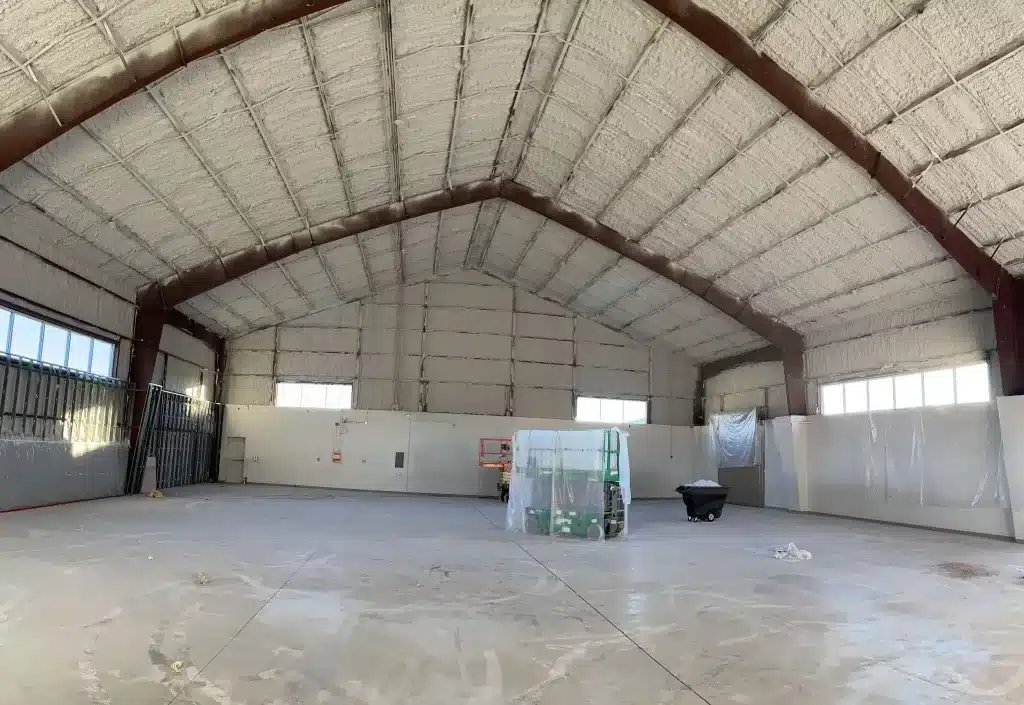
Commercial spray foam insulation is one of the most effective ways to reduce energy waste, control moisture, and improve indoor comfort in commercial buildings across Molino, FL. As a property owner operating in Florida’s hot, humid climate zone, choosing the right insulation type and application method directly impacts your operating costs and building longevity. Spray foam stands apart from traditional insulation materials because it simultaneously insulates and air-seals, closing gaps that fiber-based products cannot reach. Whether you manage a warehouse, retail space, office, or metal building, understanding how spray foam works, what the Florida Building Code requires, and how to evaluate a qualified installer will help you make a decision that protects your investment for decades. A commercial insulation guide can help building owners make informed decisions about long-term energy efficiency and building performance.
TL;DR
- Spray foam insulation delivers a higher R-value per inch than fiberglass or cellulose, with closed-cell foam reaching R-5.8 to R-6.8 per inch and open-cell foam at R-3.6 to R-3.8 per inch, according to the University of Florida’s Program for Resource Efficient Communities.
- Molino, FL, falls within Florida Climate Zone 2, which requires specific minimum R-values for commercial building envelopes under the Florida Building Code, Energy Conservation provisions.
- Spray foam acts as both an insulation layer and an air barrier, reducing the convective heat loss that the EPA’s ENERGY STAR program identifies as a major source of energy waste in commercial buildings.
- Proper installation quality matters as much as the material itself. An improperly installed thermal envelope can lose 30% or more of its rated performance.
- The EPA recommends reducing supplemental loads, including poor insulation, as a core step in its five-stage approach to commercial building energy efficiency.
- Closed-cell spray foam adds structural rigidity and resists moisture penetration, making it well-suited for Florida’s high-humidity conditions.
Why Spray Foam Insulation Matters for Molino Commercial Properties
Molino sits in Escambia County, which the Florida Building Code classifies under Climate Zone 2. In this zone, heat flows from the warm outdoors into air-conditioned interiors for the majority of the year, and that heat transfer drives up cooling costs in commercial buildings. The University of Florida’s Program for Resource Efficient Communities explains that insulation rated by R-value measures resistance to heat flow through conduction, but heat also moves through convection and radiation. Spray foam addresses all three pathways by expanding into cavities and crevices to form a continuous, seamless barrier.
Traditional insulation types like fiberglass batts or blown cellulose leave gaps around framing members, penetrations, and irregular surfaces. Those gaps allow conditioned air to escape and unconditioned air to infiltrate, forcing HVAC systems to work harder. The EPA’s ENERGY STAR program for commercial buildings notes that reducing supplemental loads, including poor insulation and leaky building envelopes, is one of the primary stages in their recommended approach to cutting commercial energy use by up to 30%.
For Molino property owners, this means spray foam does not just insulate. It seals the building envelope in a single application, which is particularly valuable in older commercial structures where air leakage has accumulated over years of construction and renovation.
Open-Cell vs. Closed-Cell Spray Foam: Which Fits Your Building?
Not all spray foam is the same. The two primary types serve different purposes, and choosing the wrong one can lead to wasted spending or insufficient protection.
Open-Cell Spray Foam
Open-cell foam is lighter, less dense, and expands significantly during application. It has an R-value of approximately R-3.6 to R-3.8 per inch. It works well for interior wall cavities and ceilings where space allows for greater thickness. Because it is vapor-permeable, it allows moisture to pass through rather than trapping it, which can be an advantage in certain wall assemblies. However, it does not add structural strength and should not be used where moisture intrusion from outside is a concern. These factors are often identified during a commercial insulation assessment before selecting the most appropriate insulation system.
Closed-Cell Spray Foam
Closed-cell foam is denser, with an R-value of R-5.8 to R-6.8 per inch. It forms a vapor-resistant barrier, adds structural rigidity to walls and roofs, and resists water absorption. In Florida’s humid climate, this makes closed-cell foam the preferred choice for metal roofs, exterior walls, crawl spaces, and any area prone to condensation or moisture exposure.
| Feature | Open-Cell Foam | Closed-Cell Foam |
|---|---|---|
| R-Value Per Inch | R-3.6 to R-3.8 | R-5.8 to R-6.8 |
| Vapor Permeability | Vapor-permeable | Vapor-resistant |
| Density | Low | High |
| Structural Support | None | Adds rigidity |
| Best Application | Interior walls, ceilings, sound-dampening | Roof decks, exterior walls, metal buildings, crawl spaces |
| Moisture Resistance | Moderate | High |
Florida Building Code Requirements for Commercial Insulation
The Florida Building Code, Energy Conservation sets minimum insulation standards that apply to all new commercial construction and major renovations in Molino and throughout Escambia County. For commercial buildings, the code specifies minimum R-values for roofs, walls, and floors based on the building’s construction type and compliance method.
For shell buildings and renovations, commercial roof assemblies in Climate Zone 2 typically require insulation rated at R-30 or higher, while walls must meet minimum R-19 standards. These requirements become even more stringent for buildings pursuing performance-based compliance through energy simulation modeling. Spray foam can help meet or exceed these requirements in thinner cavity depths compared to fiber insulation, which is a practical advantage in commercial buildings where wall thickness is limited by structural or design constraints.
The EPA also provides guidance on Building Codes for Energy Efficiency regarding lifecycle costs and energy reduction.
The code also emphasizes air barrier continuity. The building envelope must include a continuous air barrier sealed to wall assemblies, and acoustical tile ceilings and fiberglass facings do not qualify as air barriers. Spray foam, by contrast, serves as both the thermal insulation and the required air barrier in a single application, simplifying compliance.
Environmental and Health Considerations
Property owners increasingly factor environmental impact into insulation decisions. The EPA’s guide on identifying greener insulation outlines several sustainability criteria: greater thermal resistance (higher R-value), reduced or eliminated toxics such as formaldehyde and volatile organic compounds (VOCs), recycled content, and low embodied energy. Spray foam insulation manufacturers have made progress in reducing VOCs and eliminating harmful flame retardants, but not all products are equal. Ask your installer for product-specific safety data sheets and certifications.
The EPA also notes that insulation performance depends on proper installation. Compressed, gapped, or misapplied insulation loses significant thermal resistance, which is why spray foam’s ability to conform to any surface shape gives it a built-in advantage over rigid boards or batts that must be cut and fitted by hand. This is one reason property owners often choose professional spray foam services in Molino, FL for consistent insulation performance.
Signs You Have Chosen the Right Insulation Contractor
Finding a qualified spray foam installer in the Molino area requires more than comparing prices. Look for these indicators:
- Detailed written scope of work that specifies the foam type, target R-value, application thickness, and exact areas to be treated.
- Willingness to explain code compliance and how the proposed installation meets Florida Building Code requirements for your building type.
- Product transparency, including manufacturer specifications, safety data, and any relevant certifications for the foam being applied.
- Clear project timeline with realistic expectations for preparation, application, and curing periods before the space can be reoccupied.
- References from similar commercial projects in the Florida Panhandle region, demonstrating experience with local climate conditions and building types.
A contractor who cannot or will not provide these details is a red flag, regardless of how competitive their pricing may appear.
Recommendations by Building Type
Different commercial properties in Molino have distinct insulation needs. Here is guidance on which spray foam approach works best for each scenario.
| Building Type | Recommended Foam | Key Considerations |
|---|---|---|
| Metal building/warehouse | Closed-cell | Metal conducts heat rapidly; closed-cell provides thermal break and moisture barrier against roof condensation |
| Office / retail space | Open-cell or closed-cell | Open-cell works for interior partition walls; closed-cell preferred for exterior envelope and roof deck |
| Storage / climate-controlled facility | Closed-cell | Moisture control is essential to protect stored goods; closed-cell foam prevents condensation on exterior surfaces |
| Retrofit / existing building | Closed-cell (thin walls) | Higher R-value per inch allows adequate insulation in limited cavity depths common in older construction |
| New construction | Either per design | Open-cell can reduce material costs in large interior cavities; closed-cell at envelope for code compliance and durability |
Get Expert Spray Foam Insulation for Your Molino Commercial Property
Prestige Insulation Solutions LLC serves commercial property owners throughout Molino, FL, with professional spray foam insulation installation tailored to your building’s specific needs and code requirements. Our team evaluates your structure, recommends the right foam type and application depth, and completes every project to meet or exceed Florida Building Code standards. Call us at (850) 429-4969 or email [email protected] to discuss your commercial insulation project. We are ready to help you protect your building, lower your energy costs, and improve occupant comfort for the long term.
Frequently Asked Questions
What R-value does my commercial building need in Molino, FL?
Molino is in Florida Climate Zone 2, where the Florida Building Code generally requires commercial roof insulation of R-30 or higher and wall insulation of at least R-19, though exact requirements depend on your compliance method and building type.
Can spray foam insulation be installed in an existing commercial building?
Yes, spray foam can be retrofitted into existing wall cavities, roofs, and crawl spaces. Closed-cell foam is often the better choice for retrofits because its higher R-value per inch allows adequate insulation in thinner existing cavities.
How long does commercial spray foam insulation last?
When properly installed, spray foam insulation is a permanent building material that does not settle, sag, or degrade over time. It maintains its R-value and air-sealing properties for the life of the building.
Does spray foam help with humidity and moisture problems?
Closed-cell spray foam acts as a vapor barrier and resists moisture absorption, which helps prevent condensation buildup on exterior walls and roof decks, a common problem in Florida’s humid climate.
Is spray foam insulation compliant with the Florida Building Code?
Yes, spray foam insulation meets and often exceeds Florida Building Code requirements when installed at the correct depth and density. The Florida Building Code specifically permits spray foam as both insulation and an air barrier material.
Sources
- University of Florida, Program for Resource Efficient Communities – Insulation Guide – Comprehensive overview of insulation R-values, heat transfer mechanisms, and Florida-specific climate zone requirements published by the UF IFAS Extension.
- EPA ENERGY STAR for Commercial Buildings – FAQs – EPA’s five-stage technical approach to commercial building energy efficiency, including reducing supplemental loads like poor insulation.
- EPA Identifying Greener Insulation – Federal guidance on sustainability criteria for insulation materials, including thermal resistance, VOC reduction, and recycled content.
- Florida Building Code, Energy Conservation – Official state resource covering commercial building envelope R-value requirements, air barrier definitions, and compliance methods for Florida Climate Zone 2.
- EPA Building Codes for Energy Efficiency – Chapter 4.3 – Federal guidance on how building energy codes reduce lifecycle costs, peak demand, and greenhouse gas emissions in commercial construction.

- What Should You Know Before Hiring Professional Insulation Removal Services in Pensacola, FL? - October 13, 2026
- Everything You Need to Know About Professional Insulation Removal - October 7, 2026
- Which Insulation Upgrades Deliver the Best Long-Term Value in Bagdad, FL? - September 14, 2026