The right insulation for a commercial building in Pensacola depends on building type, construction method, and how you plan to use the space. Pensacola sits in IECC Climate Zone 2, a hot-humid region where cooling loads dominate for most of the year. That means the priority shifts from heat retention to heat rejection, moisture control, and air sealing. The most effective approaches combine high R-value materials with vapor management and continuous air barriers. Spray foam, rigid foam board, fiberglass batts, and radiant barriers each serve specific roles depending on whether you are insulating a metal warehouse, a retail storefront, or a multi-story office building. Choosing the right commercial insulation solutions can significantly improve long-term energy efficiency.
TL;DR
- Pensacola falls in IECC Climate Zone 2, which requires R-30 to R-49 for uninsulated attics and at least R-13 for wood-frame walls in commercial construction.
- Closed-cell spray foam delivers the highest R-value per inch and doubles as a vapor barrier and air seal, making it a strong fit for metal buildings and warehouses.
- Fiberglass and mineral wool batts remain a cost-effective choice for standard stud-wall offices and retail spaces with regular framing.
- Rigid foam board (polyiso, XPS, EPS) works well as continuous exterior insulation to eliminate thermal bridging in commercial wall assemblies.
- Radiant barriers can lower cooling costs by 5% to 10% in warm, sunny climates, especially where HVAC ducts run through unconditioned attic or roof spaces.
- Moisture management is as important as R-value in Pensacola’s humid subtropical climate, where average summer highs approach 92°F and annual precipitation exceeds 65 inches.
- Meeting code is the legal minimum. Exceeding code with better insulation improves occupant comfort, reduces energy consumption, and supports sustainability benchmarks that increasingly affect lease rates and property valuations.
Understanding Pensacola’s Climate and What It Demands
Pensacola experiences a humid subtropical climate, characterized by hot, wet summers and mild winters. According to climate data, the hottest month is July with average daily highs near 92°F, while January nights dip to around 44°F. Annual precipitation averages over 65 inches, and the area is very wet year-round. This combination of heat and humidity puts specific demands on any insulation system installed in a commercial building.
The U.S. Department of Energy places Pensacola within IECC Climate Zone 2 on its climate zone map, which is classified as warm and humid. For this zone, the DOE recommends R-30 to R-49 for uninsulated attics and R-13 for wood-frame walls without continuous insulation, or R-0 cavity fill plus R-10 continuous insulation on the exterior.
In a cooling-dominated climate like Pensacola’s, the insulation strategy needs to accomplish three things simultaneously: block conductive heat gain through walls and roofs, prevent moist outdoor air from infiltrating the building envelope, and reflect radiant heat from the sun before it enters the conditioned space.
Insulation Types That Perform Well in Pensacola’s Commercial Buildings
Closed-Cell Spray Foam Insulation
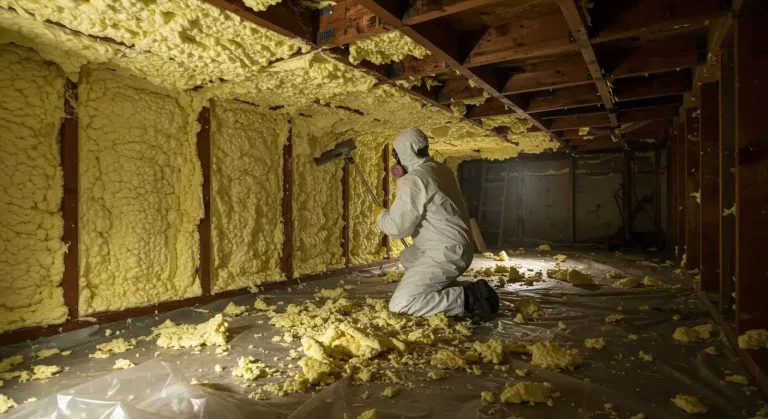
Closed-cell spray polyurethane foam delivers roughly R-6 to R-7 per inch, the highest thermal resistance of any common insulation material per unit of thickness. It also expands to fill gaps and cracks, creating an airtight seal that addresses one of the biggest energy loss drivers in commercial construction. According to the DOE, foam insulation has higher R-values than traditional batt insulation for the same thickness and forms an effective air barrier that can eliminate the need for separate weatherization steps like housewrap and caulking.
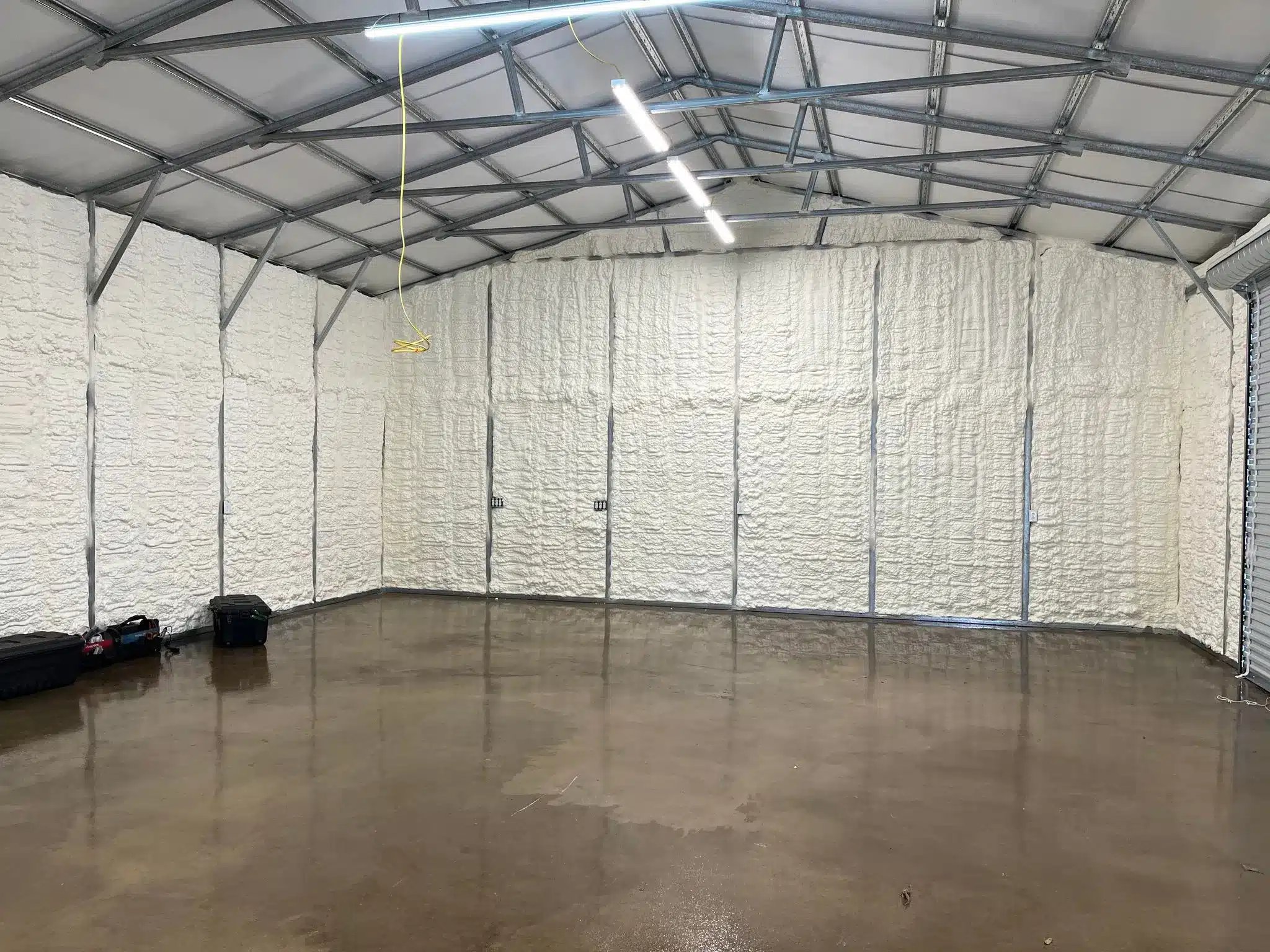
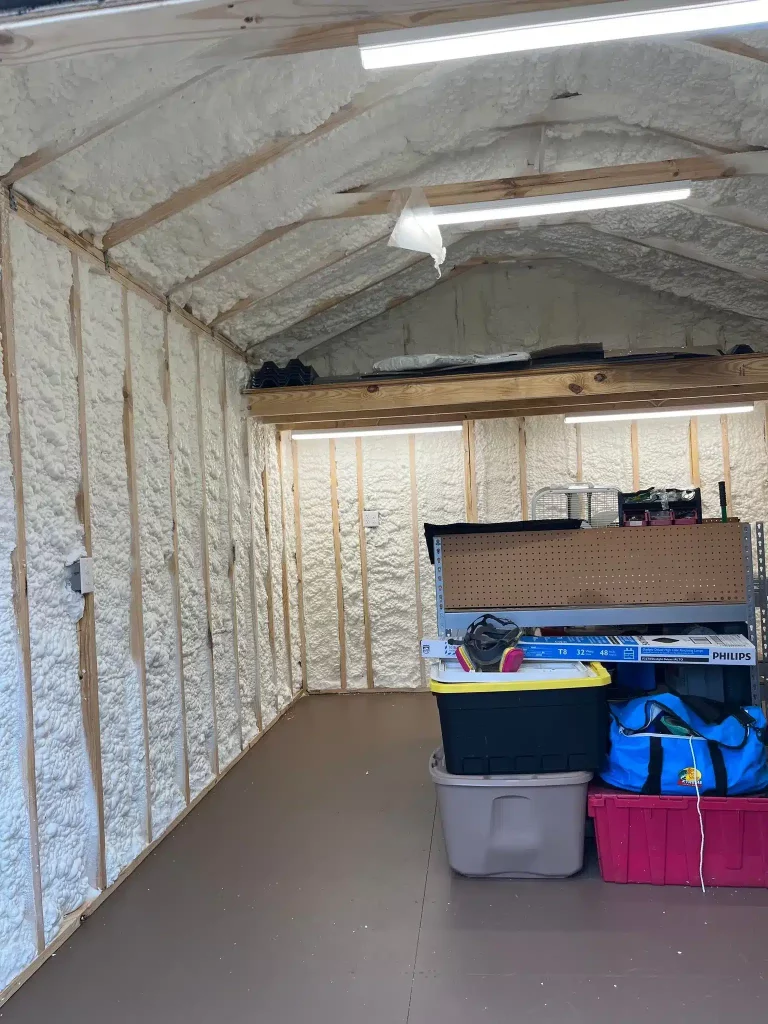
For commercial buildings in Pensacola, closed-cell spray foam is particularly effective in metal buildings, warehouses, and pole barns where air leakage through seams, joints, and penetrations is a major concern. Its closed-cell structure also acts as a vapor retarder, which helps manage moisture infiltration in a humid climate. Open-cell spray foam is a lower-cost alternative at roughly R-3.5 to R-3.7 per inch, but it should not be used in below-grade or flood-prone applications since it can absorb water. Scheduling a commercial insulation audit helps identify the most effective solution for your facility.
Fiberglass and Mineral Wool Batts
For standard commercial construction with wood or steel stud framing, fiberglass and mineral wool batts remain widely used and practical. They fit between studs, joists, and beams at standard spacing and are relatively inexpensive to install. Mineral wool offers the added benefit of fire resistance and better sound attenuation, which matters in office environments, healthcare facilities, and multi-tenant buildings where noise control between spaces is a priority.
The Insulation Institute notes that thermal comfort is a major driver of occupant satisfaction, and that meeting code alone does not guarantee comfort. In commercial settings where employee productivity and tenant retention are at stake, exceeding minimum insulation requirements with higher-density mineral wool can deliver measurable improvements in indoor temperature consistency.
Rigid Foam Board Insulation
Rigid foam boards made from polystyrene, polyisocyanurate (polyiso), or polyurethane provide high insulating value in relatively thin panels. They are especially effective when installed as continuous insulation on the exterior of wall assemblies, covering framing members and reducing thermal bridging, a common problem where studs or steel framing create conductive paths through the insulation layer.
Polyiso is commonly used in commercial roof assemblies and offers R-5 to R-6 per inch. In Pensacola, rigid foam is a practical choice for flat commercial roofs, below-grade foundation walls, and as exterior sheathing over steel or wood framing.
Radiant Barriers and Reflective Systems
Unlike bulk insulation materials that slow conductive and convective heat flow, radiant barriers reflect radiant heat away from the building interior. The DOE states that radiant barriers are more effective in hot climates and can lower cooling costs 5% to 10% in a warm, sunny climate. This makes them especially relevant in Pensacola, where cooling ducts often run through unconditioned attic or roof-ceiling assemblies.
Radiant barriers are most commonly installed in attic spaces or directly under metal roofing panels in commercial buildings. They work by reflecting radiant energy from the hot roof surface outward before it can transfer into the building. When paired with bulk insulation, radiant barriers provide a dual approach to fighting heat gain.
Comparing Insulation Solutions for Pensacola Commercial Buildings
| Insulation Type | R-Value Per Inch | Best Commercial Application | Moisture Resistance | Air Sealing Capability |
|---|---|---|---|---|
| Closed-cell spray foam | R-6 to R-7 | Metal buildings, warehouses, retrofit wall cavities | High (vapor barrier) | Excellent |
| Open-cell spray foam | R-3.5 to R-3.7 | Interior walls, sound control, large open cavities | Low (absorbs water) | Good |
| Fiberglass batts | R-2.9 to R-3.8 | Standard stud-wall offices, retail, above ceilings | Moderate (drains if wet) | Poor alone |
| Mineral wool batts | R-3.3 to R-4.2 | Fire-rated assemblies, acoustic separation | High (hydrophobic) | Poor alone |
| Rigid foam board (polyiso) | R-5 to R-6 | Commercial roofs, continuous exterior insulation | Moderate to high | Poor alone |
| Radiant barriers | No R-value | Attics, under metal roofing | N/A | N/A |
Recommendations by Building Type
Metal Buildings and Warehouses
Metal structures dominate Pensacola’s commercial landscape for storage, distribution, and light industrial use. These buildings present a significant challenge because metal framing conducts heat rapidly and panel seams are prone to air leakage. Closed-cell spray foam applied directly to the interior roof deck and walls provides the best combination of thermal resistance, air sealing, and moisture control. For larger structures where spray foam budget is a constraint, a combination of rigid foam board on the roof and fiberglass blankets (laminated insulation systems designed for metal buildings) on the walls offers a practical alternative. For project-specific recommendations, Prestige Insulation Solutions is ready to help you evaluate the best insulation strategy.
Office Buildings and Retail Spaces
Standard construction with wood or steel stud framing pairs well with fiberglass or mineral wool batts in wall cavities, supplemented by continuous rigid foam insulation on the exterior to address thermal bridging. Mineral wool is preferred where sound control between offices or retail units matters. If the building has an attic with HVAC equipment, adding a radiant barrier on the underside of the roof deck can reduce cooling load on the equipment.
Multi-Tenant and Mixed-Use Buildings
Buildings housing multiple tenants benefit from mineral wool in demising walls for fire separation and sound isolation. Spray foam in exterior wall cavities provides a continuous air barrier that prevents conditioned air loss. These buildings also benefit most from exceeding code, since energy benchmarking programs in many metro areas now require disclosure of building energy performance scores, and higher scores translate to better lease rates and lower vacancy.
Moisture Management: The Factor Many Overlook
In a humid subtropical climate, insulation alone is not enough. Moisture that enters wall cavities or roof assemblies can condense on cooler surfaces, leading to mold growth, structural deterioration, and indoor air quality problems. The approach to moisture control depends on the insulation type and the building assembly.
Closed-cell spray foam simplifies moisture management because it serves as both insulation and vapor retarder in a single application. Fiberglass and mineral wool systems require careful attention to vapor retarder placement, typically on the warm (exterior in summer) side of the assembly in hot-humid climates. Rigid foam boards with appropriate facings can also serve as vapor retarders when installed continuously on the exterior.
Proper ventilation and HVAC system design must work in coordination with the insulation strategy. Over-tightening a building without providing controlled mechanical ventilation can trap humidity indoors and create condensation problems, even with well-insulated walls and roofs.
Signs You Have the Right Insulation Partner
Choosing the right insulation installer matters as much as selecting the right material. Look for these indicators when evaluating a contractor for your Pensacola commercial project:
- They conduct a thorough assessment of your building before recommending a specific material or approach, including consideration of construction type, usage patterns, and existing conditions.
- They explain not just what product they recommend, but why it fits your climate zone and building assembly, including how moisture will be managed.
- They provide clear, written documentation covering the R-value to be achieved, the installation method, and any code compliance requirements specific to your project.
- Their team asks questions about your HVAC system, occupancy patterns, and long-term building performance goals rather than quoting a single material for every job.
- They stand behind their work with warranties that cover both materials and installation quality.
Get Your Commercial Insulation Assessment
Prestige Insulation Solutions LLC serves commercial building owners and developers throughout Pensacola, FL with insulation solutions designed for the specific demands of a hot-humid climate. Our team evaluates each building individually, considering construction type, code requirements, and your operational goals before recommending a tailored approach. Whether you are building new, retrofitting an existing facility, or upgrading an underperforming envelope, we have the experience and product knowledge to deliver lasting results.
Request a Quote | Schedule a Building Assessment
Call us at (850) 429-4969 or email [email protected] to discuss your commercial insulation project.
Frequently Asked Questions
What R-value do commercial buildings need in Pensacola, FL?
Pensacola is in IECC Climate Zone 2, which calls for R-30 to R-49 in uninsulated attics and at least R-13 in wood-frame walls. Commercial buildings following ASHRAE 90.1 may have different requirements depending on assembly type and whether continuous insulation is used.
Is spray foam worth the investment for commercial buildings?
Spray foam costs more upfront than fiberglass or rigid board, but it delivers higher R-value per inch, acts as an air barrier and vapor retarder, and fills gaps that other materials cannot reach. In metal buildings and retrofit applications, the air sealing benefit alone often justifies the investment.
How does humidity affect insulation performance in Pensacola?
High humidity means moisture control is just as important as thermal resistance. Insulation that absorbs moisture loses R-value and can promote mold. Closed-cell foam and properly detailed rigid foam assemblies handle humidity better than permeable materials like open-cell foam or unfaced fiberglass.
Can radiant barriers help in a commercial building?
Yes. Radiant barriers can reduce cooling costs by 5% to 10% in hot, sunny climates by reflecting radiant heat from the roof before it enters the building. They work best in attics or under metal roofing where HVAC ducts are present in unconditioned spaces.
What is the biggest insulation mistake in Pensacola commercial construction?
The most common mistake is focusing only on R-value while ignoring air sealing and moisture management. An insulated building that leaks air or traps moisture will underperform regardless of how much insulation is installed. A comprehensive approach that addresses heat, air, and moisture together delivers the best results.
Sources
- Department of Energy – Types of Insulation – Comprehensive guide covering all major insulation types, installation methods, and advantages for residential and commercial applications.
- Department of Energy – Insulation – Federal resource explaining R-value recommendations by climate zone, how insulation works, and the relationship between R-value, climate, and building performance.
- Insulation Institute – Why Insulate Commercial Buildings – Industry resource covering the four primary benefits of commercial insulation: energy efficiency, thermal comfort, acoustic performance, and sustainability.
- Wikipedia – Climate of Florida – Encyclopedic reference detailing Florida’s humid subtropical climate zones, temperature ranges, precipitation patterns, and regional climate variations, including the Pensacola area.
- Building America Solution Center – IECC Climate Zone Map – U.S. Department of Energy resource showing the International Energy Conservation Code climate zone designations used to determine insulation requirements by region.

- What Types of Insulation Can Be Professionally Removed From Your Home Safely and Efficiently in Pensacola, FL? - October 16, 2026
- What Should You Know Before Hiring Professional Insulation Removal Services in Pensacola, FL? - October 13, 2026
- Everything You Need to Know About Professional Insulation Removal - October 7, 2026