If you own a home or business in Mary Esther, Florida, and you are dealing with high energy bills, inconsistent indoor comfort, or moisture problems, spray foam insulation could be the solution you need. However, not all spray foam insulation projects are created equal, and choosing the right contractor makes all the difference between a system that performs for decades and one that fails within a few years. This guide covers what you need to know about selecting a qualified spray foam insulation contractor, understanding the differences between foam types, and ensuring your project meets Florida building code requirements through a complete spray foam insulation guide.
TL;DR
- Spray foam insulation can reduce energy consumption by up to 40% compared to traditional insulation materials by sealing air leaks and providing superior thermal resistance.
- Mary Esther falls within Florida Climate Zone 2, which requires minimum R-38 attic insulation and R-13 wall insulation under the Florida Building Code.
- Open-cell spray foam works well for interior applications and sound control, while closed-cell foam provides moisture resistance and structural support ideal for Florida’s humid climate.
- Always verify contractor credentials, including SPFA certification levels and proper insurance coverage, before signing any agreement.
- Professional installation is critical because spray foam requires precise application, adequate ventilation, and correct thickness to achieve the rated R-values.
Understanding Spray Foam Insulation for Florida Properties
Spray polyurethane foam (SPF) insulation has become one of the most effective materials for improving energy efficiency in both residential and commercial buildings. Unlike traditional fiberglass batts or blown-in cellulose, spray foam expands to fill gaps, cracks, and cavities, creating an airtight seal that prevents conditioned air from escaping.
According to the Spray Polyurethane Foam Alliance, spray foam serves dual functions as both insulation and an air barrier, which addresses one of the primary sources of energy loss in Florida homes. Research from the U.S. Environmental Protection Agency indicates that as much as 40% of a building’s energy can be lost through air infiltration, making air sealing just as important as thermal resistance.
For property owners in Mary Esther, the benefits extend beyond energy savings. Spray foam also helps control moisture migration, which is a persistent concern in Florida’s subtropical climate. By creating a seamless thermal envelope, spray foam reduces the conditions that lead to mold growth, wood rot, and indoor air quality problems.
Open-Cell vs. Closed-Cell Foam: Which Is Right for Your Property?
Choosing between open-cell and closed-cell spray foam depends on your property type, budget, and specific performance requirements. Understanding these differences helps you have a more productive conversation with potential contractors.
Open-cell spray foam has a lower density (typically 0.5 pounds per cubic foot) and expands more than closed-cell foam. This type provides excellent sound absorption and works well for interior wall cavities and attics where moisture exposure is minimal. Open-cell foam typically offers R-3.6 to R-3.8 per inch of thickness.
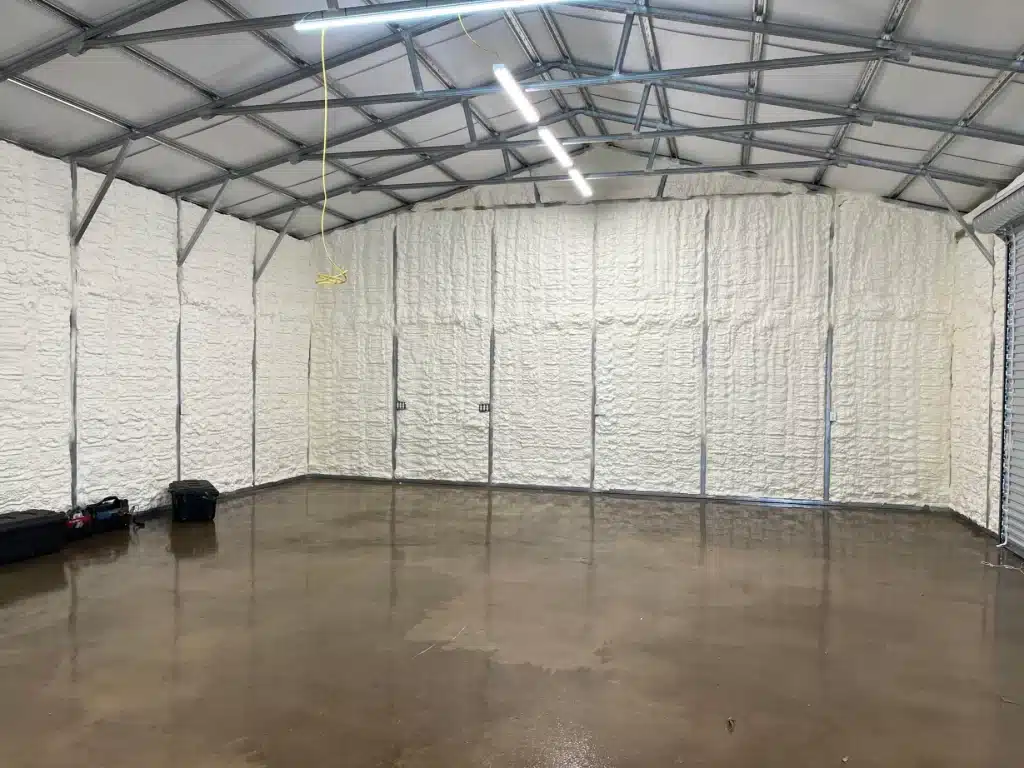
Closed-cell spray foam has a higher density (approximately 2.0 pounds per cubic foot) and provides superior moisture resistance. This makes closed-cell foam particularly well-suited for Florida applications where humidity control is critical. Closed-cell foam achieves R-6.0 to R-6.5 per inch, meaning you need less thickness to meet the same R-value targets.
For most Mary Esther residential applications, closed-cell spray foam is often the better choice due to the region’s extreme humidity and hurricane exposure risk. Open-cell foam can work well for interior soundproofing and budget-conscious projects where moisture is not a concern, but many homeowners discover that effective air sealing fails without spray foam insulation in high-humidity coastal environments.
| Foam Type | Density | R-Value per Inch | Best Applications | Moisture Resistance |
|---|---|---|---|---|
| Open-Cell | 0.5 lb/ft³ | R-3.6-R-3.8 | Interior walls, attics, sound control | Low (vapor open) |
| Closed-Cell | 2.0 lb/ft³ | R-6.0-R-6.5 | Exterior walls, crawl spaces, and roofs | High (acts as a vapor retarder) |
Florida Building Code Requirements for Spray Foam Insulation
Mary Esther is located in Florida Climate Zone 2, which means your insulation installation must meet specific minimum R-value requirements established by the Florida Building Code. According to the Florida Home Energy website, Zone 2 requires a minimum R-38 for attic insulation and R-13 for standard wall cavities.
When applying spray foam, the required thickness depends on the foam type you choose. As detailed by R-Value Associates, closed-cell spray foam achieves approximately R-6.5 per inch, meaning you would need about 5.8 inches of closed-cell foam to meet the R-38 attic requirement. Open-cell foam at R-3.7 per inch would require approximately 10.3 inches to achieve the same R-value.
These thickness requirements have practical implications for your project. For vaulted ceilings or cathedral roofs with limited rafter depth, closed-cell foam may be necessary because it achieves code compliance within tighter spaces. For standard attic applications with ample depth, open-cell foam can be a cost-effective option.
Your contractor should provide documentation showing that the proposed installation meets or exceeds Florida code requirements. This includes verifying product R-values through manufacturer test data, calculating required thickness based on your specific climate zone, and ensuring proper installation procedures are followed.
What to Look for in a Spray Foam Insulation Contractor
Not all spray foam contractors have the same level of training, experience, or commitment to quality. Here are the key factors to evaluate when selecting a contractor for your Mary Esther property.
First, verify professional certifications. The Spray Polyurethane Foam Alliance (SPFA) offers a Professional Certification Program with multiple levels, including SPF Assistant, SPF Installer, SPF Master Installer, and SPF Project Manager. Each level requires documented spraying experience and passing both written and field examinations. A contractor whose team includes certified installers demonstrates commitment to industry standards.
Second, confirm proper insurance coverage. Your contractor should carry comprehensive general liability insurance and workers’ compensation coverage to protect your property and workers in case of accidents during installation.
Third, request references from previous local projects. Ask for addresses of completed installations similar to your project scope, and follow up by contacting those property owners about their experience with the contractor’s work quality, professionalism, and post-installation support.
Fourth, evaluate the quality of the initial consultation. A reputable contractor should perform a thorough assessment of your property before providing a proposal. This assessment should include inspecting existing insulation levels, identifying air leakage points, evaluating moisture concerns, measuring cavities and attics, and explaining their recommended approach with reasoning.
Common Mistakes to Avoid When Installing Spray Foam
Even with high-quality materials, installation errors can undermine the performance of spray foam insulation. Being aware of these pitfalls helps you evaluate contractor proposals more effectively.
One common mistake is insufficient foam thickness. Spray foam must be applied at an adequate depth to achieve the rated R-value. If a contractor skimps on thickness to reduce material costs, your building will not receive the expected energy savings. Always confirm that the proposed thickness meets code minimums and your performance goals.
Another issue involves inadequate surface preparation. Spray foam requires clean, dry surfaces for proper adhesion. If contractors spray over dusty, greasy, or wet substrates, the foam may not bond correctly, leading to gaps and reduced performance.
Improper ventilation during installation is also a concern. Professional contractors should vacate the premises during spray application and follow manufacturer guidelines for re-entry times. This protects occupants from exposure to off-gassing during the curing process.
Finally, watch for contractors who quote extremely low prices. Spray foam installation requires specialized equipment, trained personnel, and quality materials. Prices significantly below market rates may indicate substandard materials, inexperienced installers, or shortcuts in the installation process.
Signs You Have Found the Right Spray Foam Contractor
A qualified spray foam insulation contractor will demonstrate several qualities that indicate they are the right choice for your project.
They explain the differences between foam types and help you understand why they recommend a specific approach for your property rather than simply pushing the most expensive option.
They provide detailed written proposals that include product specifications, thickness calculations, R-value projections, and clear scope of work descriptions.
They are transparent about timelines, potential challenges, and what you can expect during and after the installation process.
They carry relevant certifications and can provide documentation of insurance coverage, manufacturer credentials, and previous project references.
They communicate clearly and respond to questions promptly, showing that they value your business and are committed to customer satisfaction.
Request Your Spray Foam Insulation Assessment
If you are ready to explore spray foam insulation solutions for your Mary Esther home or commercial property, Prestige Insulation Solutions LLC has the expertise and certifications to handle your project. Our team includes SPFA-certified professionals with extensive experience installing spray foam in Florida’s unique climate conditions.
We provide detailed property assessments, honest recommendations, and quality installation services backed by manufacturer warranties. Whether you need to insulate an attic, walls, crawl space, or commercial building envelope, we have solutions designed for your specific requirements.
Contact us today to request a quote or schedule a consultation. You can reach our team by email at [email protected] or by phone at (850) 429-4969. Let us help you improve your property’s energy efficiency, comfort, and long-term value with professional spray foam insulation installation.
Sources
- Spray Polyurethane Foam Alliance – Contractor Certifications – Industry-standard certification programs for spray foam installers across insulation and roofing applications.
- My Florida Home Energy – Insulation Guide – State-specific guidance on insulation requirements, R-values, and Florida climate zone regulations from the University of Florida Extension Service.
- Why Spray Foam – Energy Efficiency – Comprehensive resource on how spray foam reduces energy loss, provides air sealing, and contributes to building performance.
- R-Value Associates – Spray Foam Building Code Guide – Technical reference for IRC/IBC thermal requirements, prescriptive R-values, and spray foam thickness calculations by climate zone.
Frequently Asked Questions
How long does spray foam insulation last once installed?
When properly installed, spray foam insulation can last for the life of your building. Unlike traditional insulation materials that may settle, compress, or degrade over time, spray foam maintains its R-value and structural integrity for decades without replacement.
Will spray foam help with my high air conditioning bills in summer?
Yes. Spray foam’s superior air sealing and thermal resistance reduce the workload on your HVAC system, which can lower cooling costs significantly. Many property owners notice reduced utility bills within the first few months after installation.
Is spray foam safe for my family and employees?
Modern spray foam products are safe when applied by trained professionals following manufacturer guidelines. Occupants should vacate during application and for a specified re-entry period while the foam cures. Once fully cured, spray foam is inert and does not release harmful emissions.
Can spray foam be installed in an existing home or only during construction?
Spray foam can be installed in existing homes through openings in walls, attic access points, or by removing sections of drywall. This makes it a viable upgrade option for homeowners looking to improve energy efficiency without full reconstruction.
What areas of my property should receive spray foam insulation priority?
Attics and crawl spaces typically provide the greatest return on investment because these areas experience the most significant temperature extremes and air leakage. Your contractor should assess your property to determine the most cost-effective approach based on your specific conditions and goals.

- Everything You Need to Know About Professional Insulation Removal - October 7, 2026
- Which Insulation Upgrades Deliver the Best Long-Term Value in Bagdad, FL? - September 14, 2026
- How Does Blown-In Insulation in Gonzalez, FL Fill Gaps Better Than Traditional Materials? - September 14, 2026