Air sealing without the right insulation material is like patching a boat with tape and calling it waterproof. The seams might hold for a short time, but the underlying structure still allows water, or in this case, air and heat, to move freely through the envelope. Air sealing and insulation serve two distinct functions, and when traditional insulation materials like fiberglass or cellulose are paired with even the most thorough air sealing efforts, the result is a building envelope that still underperforms. Spray foam insulation is the only material that simultaneously seals gaps and provides high thermal resistance, which is why air sealing efforts regularly fall short when spray foam is not part of the equation, making spray foam insulation installation the most effective solution for complete performance.
TL;DR
- Air sealing and insulation are two different functions, and most traditional materials only handle one of them, as noted by ENERGY STAR
- Fiberglass, cellulose, and mineral wool rely on separate air barrier materials to stop air movement, creating a two-step process prone to gaps and failures
- Spray foam insulation expands on application to fill cracks, gaps, and irregular cavities, acting as both insulation and air barrier in a single step
- Homeowners can save an average of 15% on heating and cooling costs by combining proper air sealing with insulation
- Air leaks can account for roughly one-third of a home’s total energy loss, according to building science research
- Closed-cell spray foam provides R-6.5 to R-7 per inch plus a built-in vapor barrier, outperforming fiberglass (R-2.2 to R-2.9 per inch) in nearly every application
The Fundamental Difference Between Air Sealing and Insulation
Most homeowners and even some contractors treat air sealing and insulation as interchangeable terms. They are not. Air sealing is the process of closing penetrations, cracks, and joints to stop uncontrolled air movement through the building envelope. Insulation is the material that slows conductive and convective heat transfer through walls, ceilings, and floors. The Department of Energy makes this distinction clear, explaining that heat flows through three mechanisms: conduction through materials, convection through air movement, and radiation. Insulation primarily addresses conduction and some convection, while air sealing directly targets the convective air movement that bypasses insulation entirely.
When a home has air leaks, conditioned air escapes and unconditioned air enters regardless of how much insulation sits in the wall cavities. Think of a thick winter coat with the zipper open. The coat material is doing its job, but the open gap allows cold air to pour in and warm air to rush out. Air sealing closes the zipper. The problem is that traditional insulation materials like fiberglass batts, blown cellulose, and mineral wool do not close that zipper on their own. They sit in cavities but leave gaps around framing members, electrical boxes, plumbing penetrations, and at rim joists. These gaps are where most air leakage occurs, which is why air sealing with insulation becomes critical for improving overall energy performance.
Why Traditional Insulation Cannot Seal Air
Fiberglass batts and loose-fill materials are porous by design. Air moves through them with very little resistance. In fact, fiberglass insulation works partly by trapping still air within its fibers, but when air is moving through the cavity due to pressure differences from wind, stack effect, or mechanical ventilation, that trapped air is constantly being replaced. The insulation essentially becomes a filter, not a barrier.
Building Science Corporation research shows that uncontrolled air movement through the building envelope can account for a third or more of total energy loss in typical homes. This air movement also carries moisture vapor, which condenses on cold surfaces inside wall and ceiling cavities, leading to mold growth, wood rot, and structural degradation over time. A separate air sealing step using caulks, foams, and gaskets can address some of these penetrations, but getting a continuous, durable air barrier with traditional insulation is extremely difficult in practice.
Common failure points with traditional insulation plus air sealing include:
- Rim joists and band joists where framing meets the foundation, an area with dozens of penetrations and irregular geometry
- Top plates and bottom plates where drywall meets framing and gaps are left unsealed
- Electrical and plumbing penetrations that are sealed during construction but may be missed during retrofits
- Complex framing areas such as vaulted ceilings, cantilevers, and bay windows where batts are cut and fitted, leaving voids
Even with careful air sealing work, the building science community recognizes that separate air barrier systems and insulation systems must be perfectly aligned to perform as intended. In the field, that alignment is rarely achieved.
How Spray Foam Insulation Solves Both Problems
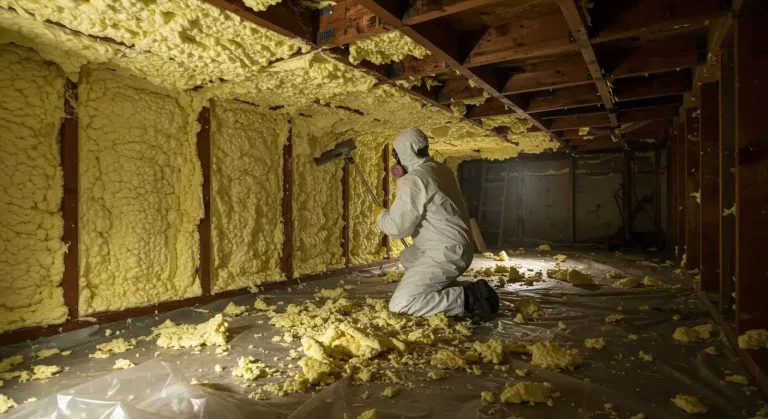
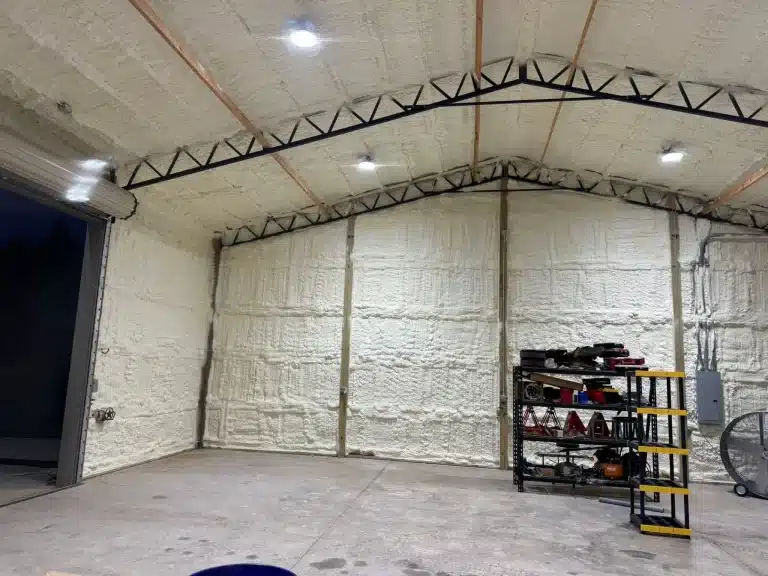
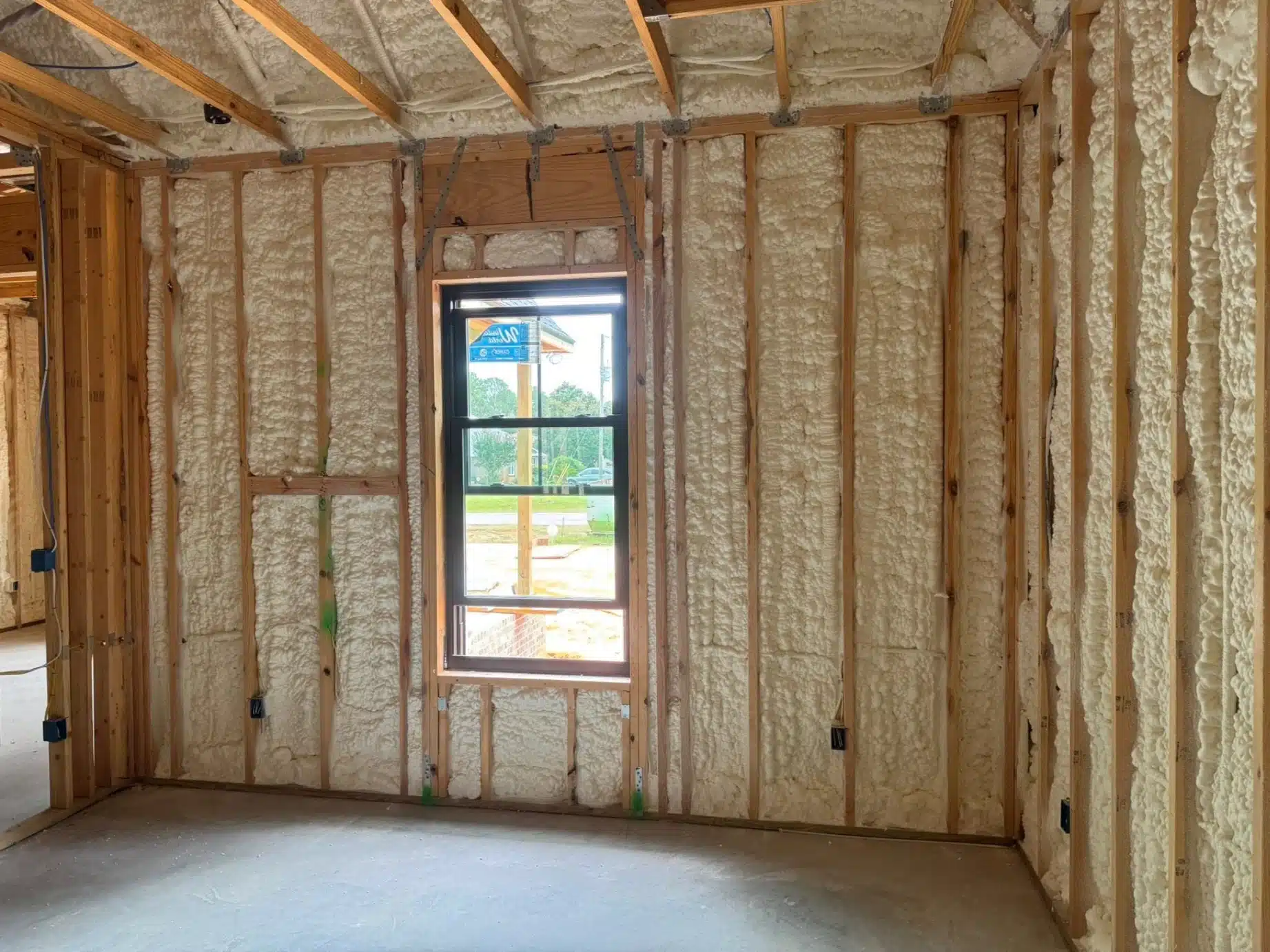
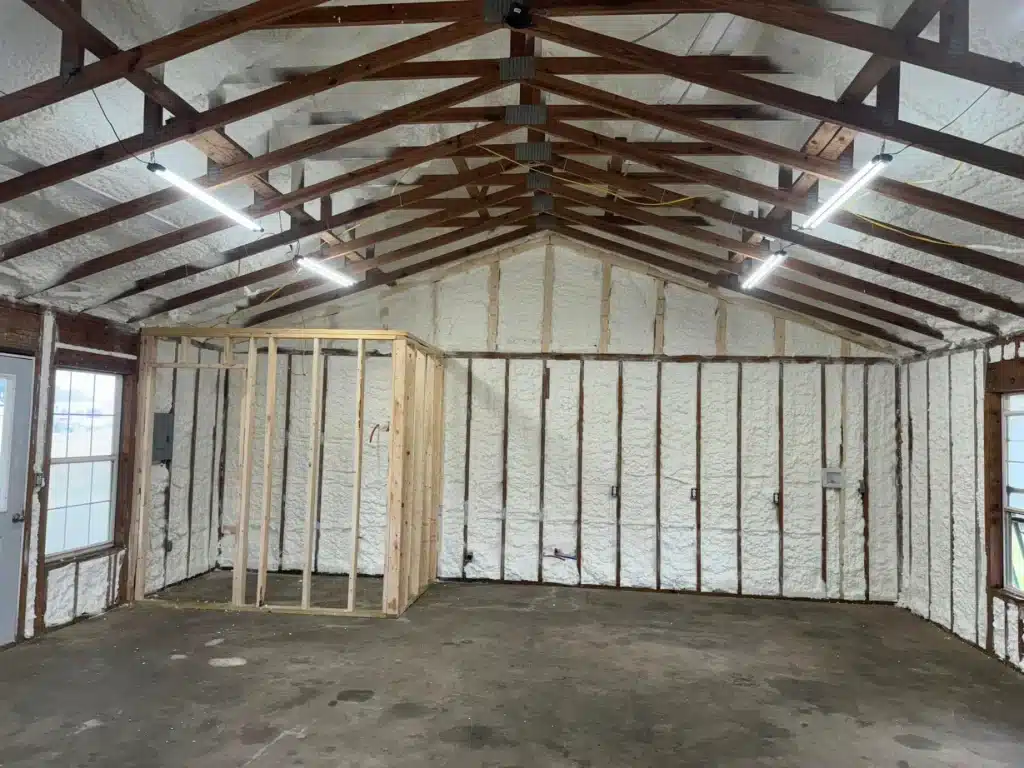
Spray foam insulation is applied as a liquid that expands to fill the cavity it is sprayed into. As it expands, it conforms to irregular surfaces, wraps around obstructions, and seals every crack, gap, and penetration in the application area. This dual action, insulating and air sealing simultaneously, is what sets spray foam apart from every other insulation material on the market.
The DOE’s Building Science Education resource states directly that spray foam insulation can be used at rim joists, floors above unconditioned space, and in attics to insulate and air seal at the same time. This is not a secondary benefit or a marketing claim. It is a documented building science principle.
There are two primary types of spray foam, each suited to different applications:
| Spray Foam Type | R-Value per Inch | Air Barrier | Vapor Barrier | Best Application |
|---|---|---|---|---|
| Open-cell | R-3.5 to R-3.7 | Yes | No | Wall cavities, attics, sound dampening |
| Closed-cell | R-6.0 to R-7.0 | Yes | Yes (Class II) | Rim joists, crawlspaces, basements, exterior sheathing |
Closed-cell spray foam offers the highest performance per inch and adds structural rigidity to the assembly. Its vapor retarder qualities make it the preferred choice for below-grade applications and areas with high moisture risk. Open-cell spray foam provides excellent air sealing at a lower material cost but requires a separate vapor barrier in some climate zones.
Performance Comparison: Spray Foam vs. Traditional Materials
The difference in real-world performance between spray foam and traditional insulation is not marginal. It is significant enough to change the comfort, durability, and energy cost of a home. Here is a direct comparison:
| Insulation Type | R-Value per Inch | Air Barrier | Vapor Barrier | Gaps & Void Filling | Long-Term Settling |
|---|---|---|---|---|---|
| Closed-cell spray foam | R-6.0 to R-7.0 | Yes | Yes | Expands to fill completely | None |
| Open-cell spray foam | R-3.5 to R-3.7 | Yes | No | Expands to fill completely | None |
| Fiberglass batts | R-2.2 to R-2.9 | No | No | Leaves gaps around penetrations | Can settle and sag |
| Blown cellulose | R-3.1 to R-3.8 | Partial | No | Fills cavities but not gaps | Settles over time |
| Mineral wool batts | R-3.0 to R-4.2 | No | No | Leaves gaps around penetrations | Minimal settling |
Beyond the R-value numbers, what matters most is the effective R-value, which accounts for air movement through the assembly. A fiberglass wall cavity rated at R-13 might perform at R-8 or less in real conditions due to air bypass, convection loops within the cavity, and thermal bridging through framing. Oak Ridge National Laboratory research has documented that spray foam’s combined ability to seal small leaks, add R-value, and provide a vapor-diffusion retarder gives it a measurable performance advantage over traditional insulation materials that rely on separate air barrier systems. Spray foam assemblies deliver effective performance much closer to their rated R-values because the material eliminates the air movement that degrades traditional insulation performance.
Real-World Examples: When Air Sealing Falls Short
We have seen the consequences of separating air sealing from insulation material selection across a wide range of projects. These scenarios illustrate common patterns of failure:
| Scenario | Home Type | Problem | Solution | Outcome |
|---|---|---|---|---|
| Rim joist retrofit | 1985 two-story colonial | Extensive air sealing with caulk and rigid foam board over rim joists, but air still leaked through framing gaps and around penetrations | Removed rigid board, applied 2 inches of closed-cell spray foam directly to rim joist bays | Air leakage reduced by over 60%, basement temperature stabilized |
| Attic insulation upgrade | 1970s ranch with blown fiberglass | Homeowner added R-30 blown fiberglass over existing R-11 batts without sealing attic floor penetrations | Removed blown fiberglass, air sealed all top plates and penetrations, then applied open-cell spray foam to attic floor | Heating costs dropped 22% the following winter |
| New construction wall assembly | Custom-built 2,400 sq ft home | Builder used fiberglass batts with house wrap as the air barrier, but blower door test showed 7 ACH50 | Applied closed-cell spray foam at rim joists and behind electrical boxes, supplemented wall cavities | Achieved 3.2 ACH50, well below code requirement |
| Crawlspace encapsulation | 1990s split-level with vented crawlspace | Sealed crawlspace vents and installed 6-mil vapor barrier, but floors above remained cold and humid | Applied 2 inches of closed-cell spray foam to crawlspace walls and band joist | Floor temperatures increased 8 degrees, humidity issues resolved |
| Vaulted ceiling retrofit | 1960s cape cod with cathedral ceilings | Air sealing attempted from interior with caulk and foam, but cathedral ceiling cavities remained inaccessible | Dense-packed existing cavities would not reach air barrier; removed interior finish, sprayed closed-cell foam to sheathing | Eliminated ice dams, reduced heating load measurably |
Factors That Affect Air Sealing and Insulation Performance
Several variables determine how well an air sealing and insulation system will perform in practice. Understanding these factors helps explain why spray foam consistently outperforms other options:
Climate zone classification – Colder climates (zones 5 through 8) demand higher R-values and tighter air barriers. The EPA data shows that northern homes in climate zones 6 through 8 can save 14 to 16% on total energy costs from combined sealing and insulation, compared to only 5 to 8% in southern zones 1 through 3. The pressure differences caused by stack effect are also stronger in cold climates, making air sealing failures more consequential.
Foam thickness and coverage – The R-value delivered depends directly on the installed thickness. Closed-cell foam at 1 inch delivers approximately R-6.5, while 2 inches delivers R-13. Achieving the correct thickness across the entire application area requires trained installers and proper equipment calibration.
Building age and construction type – Older homes built before modern energy codes often have balloon framing, uninsulated cavities, and numerous unsealed penetrations. These homes benefit most from spray foam because the material can reach areas that are impossible to access with batts or rigid board.
Moisture and vapor diffusion – In mixed and cold climates, vapor control is critical. Closed-cell spray foam acts as a vapor retarder at 1.5 inches or greater, preventing moisture from condensing inside wall assemblies. This dual capability, air barrier plus vapor retarder, eliminates the need for separate polyethylene sheeting that can trap moisture if installed incorrectly.
Installation quality – Spray foam application requires specific temperature ranges, proper substrate preparation, and trained technicians. Improperly installed foam can shrink, off-gas, or fail to adhere to surfaces, negating its air sealing benefits. This is where working with experienced professionals makes a measurable difference.
Actionable Strategies for Better Results
Contractors and homeowners looking to improve building envelope performance should consider these steps:
- Prioritize air sealing before adding any insulation – Air sealing should always precede insulation installation. Adding insulation over unsealed cavities can actually make moisture problems worse by trapping humid air inside the assembly.
- Use spray foam at critical air barrier locations – Even if the budget does not allow for full spray foam insulation, targeting rim joists, cantilevers, bay windows, and attic floor penetrations with spray foam delivers disproportionate benefits relative to the cost.
- Conduct blower door testing before and after – The only way to verify air sealing effectiveness is with a blower door test. Use it as a diagnostic tool before work begins and as a quality assurance check after completion.
- Select insulation based on the specific application – Closed-cell foam for below-grade and high-moisture areas, open-cell for large wall cavities and attics where sound control is also a priority, and never rely on fiberglass or cellulose alone as an air barrier strategy.
- Ensure proper ventilation in tight homes – As buildings become tighter through spray foam air sealing, mechanical ventilation becomes necessary to maintain indoor air quality. Plan for this from the start of any insulation project.
Get a Professional Air Sealing and Insulation Assessment
Prestige Insulation Solutions LLC specializes in identifying exactly where air sealing fails and applying spray foam insulation to fix it. Our team evaluates your entire building envelope, pinpointing the gaps, penetrations, and insulation deficiencies that are driving up your energy bills and reducing your comfort. We use spray foam insulation to deliver both the thermal resistance and the continuous air barrier your home needs in a single application.
Request a Free Quote | [email protected] | (850) 429-4969
Sources
- Department of Energy – Insulation – Comprehensive federal resource covering insulation types, R-values, climate zone requirements, and the relationship between insulation, air sealing, and moisture control.
- DOE Building Science Education – Tight Air-Sealed Homes – Government educational resource explaining how air-sealed homes work, including specific guidance on spray foam for simultaneous insulation and air sealing.
- ENERGY STAR – Why Seal and Insulate – EPA consumer guide detailing energy and comfort benefits of combined air sealing and insulation, including the statistic that 9 out of 10 U.S. homes are under-insulated.
- Building Science Corporation – Air Leaks: How They Waste Energy and Rot Houses – Research by John Straube documenting that air leaks can account for a third or more of energy loss and cause moisture-related structural damage.
- ENERGY STAR – Methodology for Estimated Energy Savings – EPA data showing estimated savings by climate zone, with national average savings of 11% on total energy costs and 15% on heating and cooling costs from air sealing and insulation.
- Oak Ridge National Laboratory – Spray Foam in Accessible Spaces: Best Practices and Case Studies – ORNL research documenting spray foam’s ability to seal small leaks, add R-value, and provide a vapor-diffusion retarder in residential building applications.
Frequently Asked Questions
Can fiberglass insulation work as an air barrier?
No. Fiberglass is a porous material through which air moves with very little resistance. It slows conductive heat transfer but does not stop air leakage. A separate air barrier system using caulks, gaskets, and rigid materials must be installed alongside fiberglass for the assembly to perform properly.
Is spray foam insulation worth the higher upfront cost?
Yes, particularly in applications where air sealing and moisture control are critical, such as rim joists, crawlspaces, and cathedral ceilings. The combined insulation and air barrier performance of spray foam delivers better energy savings, improved comfort, and reduced risk of moisture damage compared to traditional materials that require separate air barrier installation.
Does air sealing alone reduce energy bills?
Air sealing alone does reduce energy bills. EPA estimates savings of 11% on total energy costs when air sealing is combined with attic, crawlspace, and basement insulation. However, air sealing without adequate insulation leaves the conductive heat transfer path open, so maximum savings require both measures working together.
What is the difference between open-cell and closed-cell spray foam?
Open-cell spray foam is lighter, less expensive, and has a lower R-value per inch (R-3.5 to R-3.7). It air seals well but does not act as a vapor barrier. Closed-cell spray foam is denser, provides R-6.0 to R-7.0 per inch, acts as both an air barrier and a vapor retarder, and adds structural strength to the assembly. Closed-cell is generally preferred for basements, crawlspaces, and exterior applications.
How do I know if my home needs spray foam insulation?
Common signs include uneven temperatures between rooms, high energy bills, drafty areas near windows and baseboards, visible moisture or mold in attics or crawlspaces, and ice dams forming on the roof edge in winter. A blower door test conducted by a professional can quantify air leakage and help determine where spray foam would deliver the greatest benefit.

- What Should You Know Before Hiring Professional Insulation Removal Services in Pensacola, FL? - October 13, 2026
- Everything You Need to Know About Professional Insulation Removal - October 7, 2026
- Which Insulation Upgrades Deliver the Best Long-Term Value in Bagdad, FL? - September 14, 2026