Pensacola homeowners are replacing outdated insulation with residential spray foam because the Gulf Coast’s hot, humid climate punishes traditional materials like fiberglass and cellulose. Moisture infiltration, air leakage, and settling degrade old insulation over time, driving up cooling costs and creating conditions for mold growth. Spray foam addresses all three problems simultaneously by sealing gaps, resisting moisture, and delivering significantly higher R-value per inch than any conventional insulation, making residential spray foam insulation upgrades worth considering for homes with aging or underperforming insulation. The right choice between open-cell and closed-cell spray foam depends on whether the priority is air sealing, moisture resistance, or total R-value target, and understanding that distinction is what separates a lasting upgrade from a wasted investment.
TL;DR
- Pensacola sits in ASHRAE Climate Zone 2, where ENERGY STAR recommends a minimum of R-30 to R-38 for uninsulated attics in hot-humid zones, a target old fiberglass often falls far short of
- Closed-cell spray foam delivers approximately R-6.0 per inch, while open-cell delivers about R-3.5 per inch, both outperforming fiberglass at R-2.2 per inch that degrades further when exposed to moisture
- ORNL research in mixed-humid climates showed spray foam retrofits reduced whole-house air infiltration by up to 40% and lowered air changes per hour (ACH@50Pa) from 10-15 down to as low as 4.21
- Old fiberglass insulation absorbs moisture in Pensacola’s high-humidity environment, loses R-value, settles over time, and can obstruct attic airflow, all of which undermine cooling efficiency
- EPA recognizes SPF as a highly effective insulation and air sealant, but proper safety protocols during installation are required due to isocyanate exposure risks
- NREL field studies across hot, rainy climates (including Miami and New Orleans) confirmed spray foam roof assemblies maintain safe moisture content levels in wood sheathing, even under significant rainfall exposure
- Hybrid approaches like “flash-and-batt” or “flash-and-fill” combine a thin layer of closed-cell foam with fiberglass or open-cell foam, achieving high total R-values at lower material cost
How Pensacola’s Climate Breaks Down Old Insulation
Pensacola endures long, sticky summers with frequent rain and coastal humidity that creates a uniquely hostile environment for conventional insulation. According to ENERGY STAR’s recommended R-value guidelines, homes in Climate Zone 2 need attic insulation levels of R-30 to R-38 depending on existing conditions. The problem is that most older homes in the area were insulated with fiberglass batts or blown-in material that has been losing ground for years.
Fiberglass insulation relies on trapped air pockets to resist heat flow. In a humid climate, those air pockets absorb moisture, which degrades the thermal resistance. The material also settles under gravity, leaving gaps at the top of wall cavities and thinning across attic floors. Wikipedia’s building insulation reference notes that around 40% of energy consumption in buildings is attributed to heating and cooling, and inadequate insulation is one of the leading causes of that waste. When your attic insulation has compressed from 10 inches down to 6, you are not getting the R-30 your home was designed for, and your HVAC system works harder every summer to compensate.
Beyond thermal performance, old insulation in Pensacola homes faces a more direct threat: moisture. Gulf Coast humidity finds its way into attics and wall cavities through gaps around recessed lights, plumbing penetrations, electrical boxes, and where walls meet ceilings. Once moisture enters, fiberglass does nothing to stop it. The material absorbs water, holds it against wood framing, and creates the conditions for mold growth and wood rot. The ORNL spray foam retrofit study found that 70 to 90% of moisture passing through a building envelope comes from air leakage, not diffusion, making air sealing the first line of defense.
What Makes Spray Foam Different
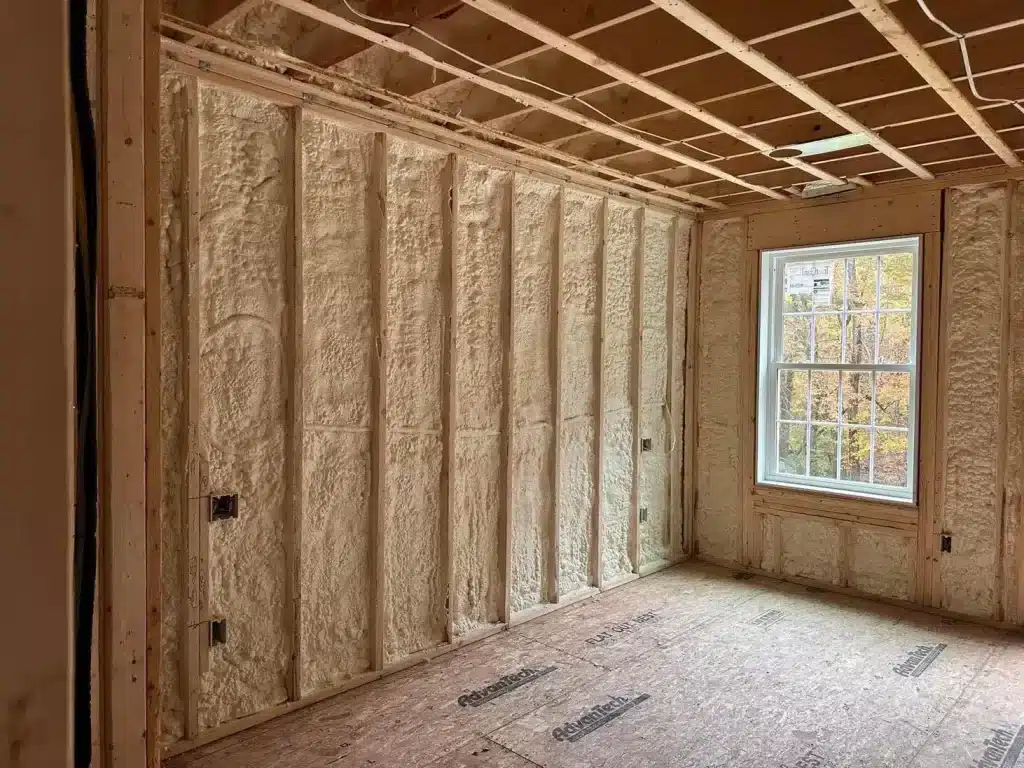
Spray polyurethane foam (SPF) insulation is fundamentally different from traditional materials because it expands into place and cures as a continuous solid. That expansion allows it to fill gaps, cracks, and voids that fiberglass batts cannot reach, creating both an insulating layer and an air barrier in a single application.
The EPA describes SPF as a highly effective and widely used insulation and air sealant, noting its ability to seal the building envelope while adding thermal resistance. The ORNL study compared the two primary types:
| Property | Closed-Cell SPF | Open-Cell SPF |
|---|---|---|
| R-value per inch | ~6.0 | ~3.5 |
| Moisture permeability | Low (acts as vapor retarder) | Higher, but controlled |
| Air barrier | Yes | Yes, if sufficiently thick |
| Water resistance | Resists water absorption | Should not contact water directly |
| Density (lb/ft3) | 1.75 to 2.25 | 0.4 to 1.2 |
| Sound absorption | Good | Very good |
Closed-cell foam is the stronger all-around performer for Pensacola’s climate because it resists moisture infiltration and serves as a vapor retarder. Open-cell foam is less expensive per R-value and provides better sound dampening, making it a solid choice for interior wall cavities where direct water contact is not a concern. Many local installations use a hybrid approach: a base layer of closed-cell foam for air sealing and moisture control, topped with open-cell foam or fiberglass to reach the target total R-value. Homeowners can use this residential spray foam guide to compare these approaches based on climate, application area, moisture exposure, and performance requirements.
The Real-World Performance Data
Government research backs up what Pensacola homeowners are experiencing firsthand. The ORNL study documented deep energy retrofits on ten older homes in the mixed-humid climate of East Tennessee, a region with humidity and temperature patterns comparable to the Florida Panhandle. The results were striking:
- Air infiltration dropped dramatically. Homes that started at 10 to 15 air changes per hour (ACH@50Pa) fell to as low as 4.21 after spray foam application
- Energy savings were measurable. One retrofit home (CC2) saw a 40% reduction in whole-house air infiltration and a 17% decrease in heating and cooling energy use, saving an estimated 4,768 kWh per year
- Attic temperatures stabilized. In the sealed and foam-insulated attic, summer temperatures remained below 83 degrees Fahrenheit, while the control house with a vented attic reached 133 degrees
The NREL/Building Science Corporation study specifically modeled spray foam roof assemblies in Miami (Climate Zone 1), which shares Pensacola’s heat and rainfall characteristics. The modeling found that both closed-cell and open-cell spray foam roof assemblies were able to safely dry out incidental moisture from minor rainwater leakage. Open-cell foam in particular dried more readily in hot climates, with the Miami analysis showing the full 1% modeled rainwater leak was easily managed by the roof system.
These findings matter because they confirm spray foam is not just a theoretical improvement. In climates like Pensacola’s, the material actively manages moisture while maintaining thermal performance, something fiberglass simply cannot do.
Where Spray Foam Makes the Biggest Impact in Pensacola Homes
Not every insulation upgrade delivers the same return. For Pensacola homeowners deciding where to start, three areas consistently produce the most noticeable results.
Attics and roof decks. Most older homes in the area have ductwork running through vented attics that reach 130 degrees or more in summer. Every degree of heat gained in that attic forces the air conditioning system to work harder. Spray foam applied to the underside of the roof deck converts the attic into a conditioned space, keeping duct temperatures close to indoor air temperature and eliminating the single largest source of cooling loss.
Crawlspaces. Vented crawlspaces in humid climates pull moisture-laden air into the home, which then circulates through wall cavities and floor assemblies. Sealing and insulating the crawlspace with closed-cell spray foam eliminates this moisture pathway and can improve indoor air quality throughout the home.
Rim joists and band joists. The rim joist area where the floor framing meets the exterior wall is one of the most leaky parts of any building envelope. ORNL’s retrofit checklist identifies this as a priority sealing location because it is a major source of both air infiltration and energy loss.
Closed-Cell vs. Open-Cell: Which Fits Your Pensacola Home
The choice between foam types depends on the application and budget. Here is a practical comparison:
| Factor | Closed-Cell Foam | Open-Cell Foam |
|---|---|---|
| Best application | Attic roof decks, crawlspaces, rim joists | Wall cavities, sound-dampening projects |
| Moisture control | Serves as vapor retarder | Allows vapor diffusion; needs coating in some zones |
| R-value target | Achieves high R-value in thin layers | Requires more depth for same R-value |
| Structural benefit | Adds rigidity to framing | Minimal structural benefit |
| Budget impact | Higher per-inch cost | Lower per-inch cost, needs more thickness |
For most Pensacola homeowners, the practical approach is a combination: closed-cell foam in moisture-critical areas like crawlspaces and roof decks, with open-cell or a hybrid system in wall cavities where cost and sound dampening are bigger priorities.
Signs Your Old Insulation Needs Replacement
Not every home with old insulation needs a full replacement. But several indicators suggest the current material has reached the end of its useful life:
- Rising energy bills. Gradual increases in summer cooling costs often trace back to degraded attic insulation, a pattern documented by energy auditors across the country
- Visible settling or gaps. If attic insulation has thinned to less than the recommended depth, or has shifted away from eaves and penetrations, it is underperforming
- Moisture damage or mold. Any signs of mold on attic sheathing, damp insulation, or water staining around penetrations indicate the insulation has failed to manage moisture
- Indoor humidity problems. If your home feels persistently humid despite running the air conditioning, air leakage and moisture infiltration through compromised insulation may be the cause
- Temperature inconsistencies. Hot and cold spots from room to room, especially upstairs versus downstairs, often indicate uneven or insufficient insulation coverage
What to Look for in a Spray Foam Contractor
Choosing the right installation team matters as much as choosing the right material. The EPA provides detailed safety guidance for SPF installation, including requirements for protective equipment, ventilation during application, and safe re-entry times. A qualified contractor should:
- Explain the installation process, including what areas need to be prepped and how long occupancy may be affected
- Specify the type and thickness of foam planned for each area of the home
- Describe how they will verify the foam has been applied to the specified depth
- Follow EPA-recommended safety protocols, including proper ventilation and protective equipment during application
- Provide documentation of the products used and their safety data sheets
Get Started With Your Pensacola Spray Foam Upgrade
Prestige Insulation Solutions LLC serves Pensacola homeowners with professional residential spray foam insulation designed for the specific demands of the Gulf Coast climate. Our team evaluates your existing insulation, identifies air leakage points, and recommends the right combination of open-cell and closed-cell spray foam for your home’s needs. Whether you are dealing with a humid crawlspace, an underperforming attic, or outdated wall insulation, we handle the full process from assessment through installation.
Request a Quote | Schedule an Insulation Assessment
Call us at (850) 429-4969 or email [email protected] to discuss your project. We provide straightforward recommendations backed by building science, not upselling.
FAQs
How long does residential spray foam insulation last?
Spray foam does not settle, degrade, or absorb moisture the way fiberglass does, making it a permanent upgrade that performs for the life of the building when properly installed.
Can spray foam be installed over existing fiberglass insulation in my attic?
In most retrofit cases, the old insulation needs to be removed first to gain access to air leakage sites and to avoid trapping moisture between the old and new layers.
Is spray foam safe for my family after installation?
Once cured, spray foam is inert and non-toxic. The EPA notes that exposure risks occur during and immediately after application, which is why proper ventilation and re-entry protocols are important during the installation process.
Will spray foam help with my summer cooling bills in Pensacola?
By sealing air leaks and providing higher R-value per inch than fiberglass, spray foam reduces the load on your air conditioning system, which is the largest energy consumer in a Pensacola home during summer.
Do I need to leave my home during spray foam installation?
The EPA recommends that building occupants vacate during high-pressure spray foam application and follow the contractor’s guidance on safe re-entry times, which vary based on the type and amount of foam applied.
Sources
- EPA – Spray Polyurethane Foam (SPF) Insulation and How to Use it More Safely – Comprehensive EPA guidance on SPF types, safety protocols, health considerations, and proper installation practices for contractors and homeowners.
- ENERGY STAR – Recommended Home Insulation R-Values – Official DOE/ENERGY STAR tables specifying minimum cost-effective insulation R-values by climate zone for retrofits of existing wood-framed buildings.
- ORNL – Spray Foam in Accessible Spaces: Best Practices and Case Studies for Retrofit in Mixed-Humid Climates – Oak Ridge National Laboratory research documenting deep retrofit case studies, blower door test data, air sealing checklists, and hybrid foam application methods for existing homes.
- Wikipedia – Building Insulation – Reference article covering insulation types, thermal performance fundamentals, climate-specific strategies, and the role of insulation in building energy efficiency.
- NREL/DOE Building America – Application of Spray Foam Insulation Under Plywood and OSB Roof Sheathing – Building Science Corporation study modeling hygrothermal performance of spray foam roof assemblies in hot, cold, and marine climates, with field moisture content readings from in-service homes.

- What Types of Insulation Can Be Professionally Removed From Your Home Safely and Efficiently in Pensacola, FL? - October 16, 2026
- What Should You Know Before Hiring Professional Insulation Removal Services in Pensacola, FL? - October 13, 2026
- Everything You Need to Know About Professional Insulation Removal - October 7, 2026