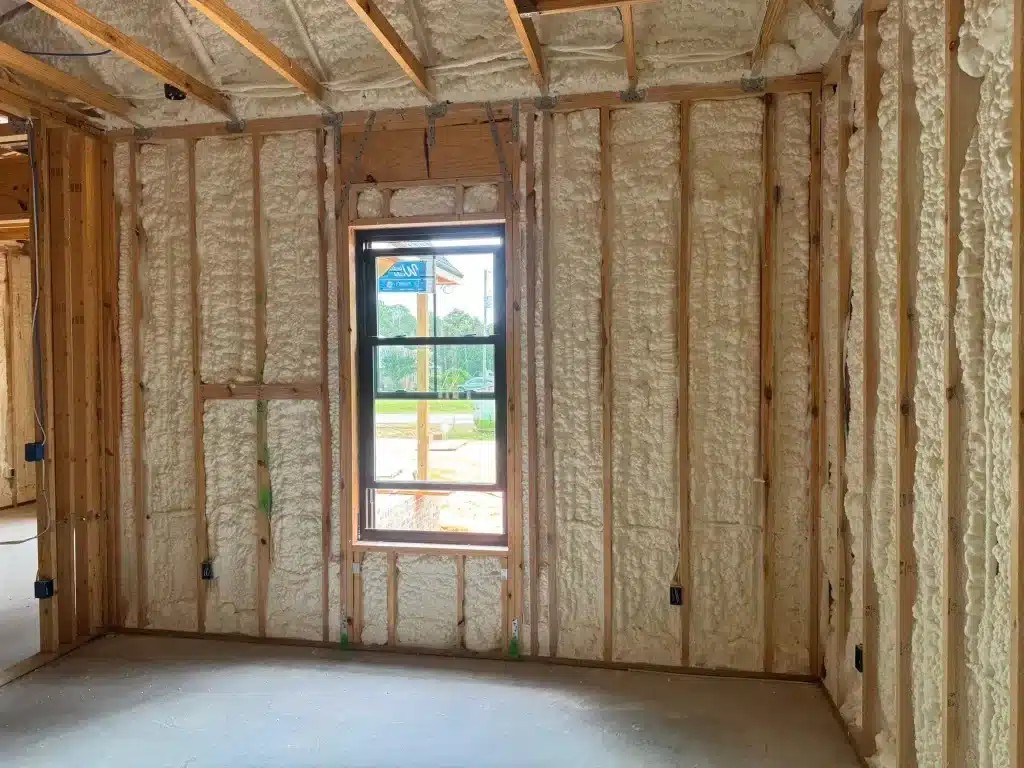
Spray foam insulation stops drafts more effectively than blown-in insulation in Milton, FL, and the reason comes down to how each material interacts with air movement. Spray foam expands on contact, filling gaps, cracks, and penetrations to form an airtight seal against the building envelope. Blown-in insulation, whether cellulose or fiberglass, fills wall and attic cavities with loose material that resists conducted heat well but does not create a sealed barrier against air infiltration. In Milton’s hot-humid climate (IECC Climate Zone 2), sealing against humid air infiltration is as important as the R-value itself, because unconditioned outdoor air carries moisture that forces HVAC systems to work harder on dehumidification. When the goal is eliminating drafts, a spray foam insulation guide can help homeowners understand why spray foam is the clear choice, though blown-in insulation has its own strengths in specific applications and budgets.
TL;DR
- Spray foam creates an airtight seal by expanding into gaps, cracks, and penetrations, making it the superior option for stopping drafts
- Blown-in insulation (cellulose or fiberglass) resists conducted heat effectively but does not seal against air leaks on its own
- Closed-cell spray foam delivers R-5.5 to R-6.5 per inch, while open-cell spray foam provides R-3.6 to R-3.8 per inch
- Blown-in cellulose and fiberglass both fall in the R-2.5 to R-3.8 per inch range
- Milton, FL sits in Climate Zone 2, where ENERGY STAR recommends attic insulation at R-49 and floor insulation at R-13 for retrofits
- In hot-humid climates, air sealing matters as much as R-value because moisture-laden air infiltration drives up cooling costs
- Blown-in is a strong fit for attics, existing wall cavities, and budget-conscious projects where full air sealing is addressed separately
- The Federal Trade Commission’s R-Value Rule requires accurate R-value labeling so homeowners can compare products on equal terms
How Each Insulation Type Works
Spray Foam Insulation
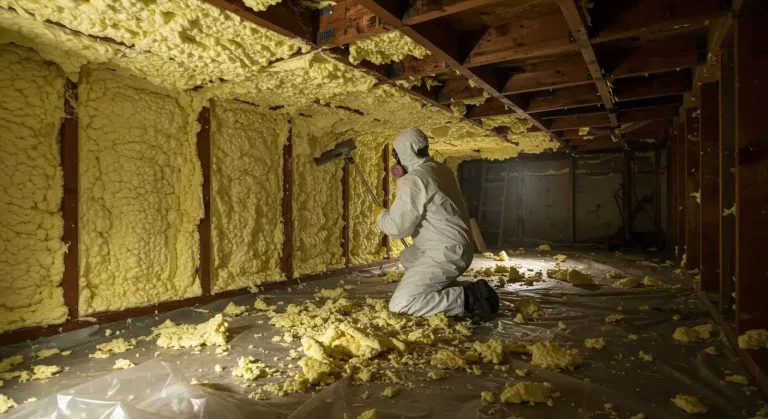
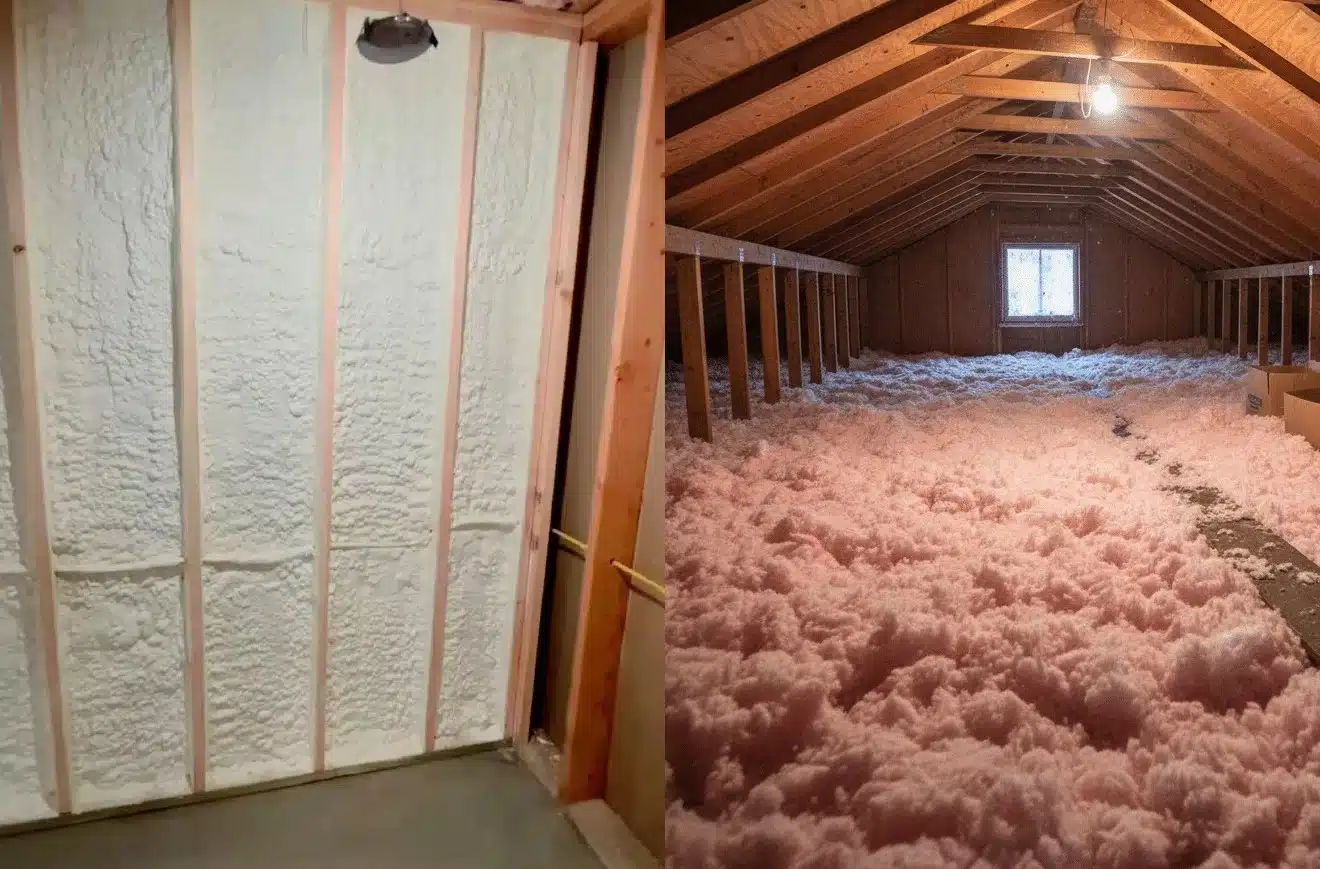
Spray foam is applied as a liquid mixture that expands and cures into a solid foam. It comes in two main varieties. Closed-cell spray foam forms a dense, rigid material that resists moisture, adds structural strength, and acts as a vapor barrier. It delivers R-5.5 to R-6.5 per inch, making it one of the highest-performing insulation materials available per inch of thickness R-value). Open-cell spray foam is lighter, less dense, and vapor-permeable, with an R-value of R-3.6 to R-3.8 per inch.
The defining advantage of spray foam is its air-sealing capability. As it expands, it fills bypasses, seals penetrations around plumbing and electrical runs, and conforms to irregular surfaces. This creates a continuous air barrier that blown-in insulation cannot match on its own.
Blown-In Insulation
Blown-in insulation includes cellulose (made primarily from recycled newspaper) and fiberglass loose-fill. These materials are pneumatically blown into wall cavities, attics, and hard-to-reach spaces through hoses. A professional insulation contractor can help determine whether blown-in materials or spray foam is more appropriate for a specific assembly. Blown-in cellulose delivers R-3.0 to R-3.8 per inch, while blown-in fiberglass provides R-2.5 to R-3.7 per inch.
Blown-in insulation conforms well to irregular spaces and fills around framing members better than batts. Dense-pack cellulose in particular provides good resistance to air movement. However, it does not permanently seal gaps the way expanding foam does. Over time, dry-spray cellulose can settle up to 20% of its original volume, which may reduce effectiveness if not properly installed, making local insulation services a practical option for homeowners who need professional assessment or installation.
Head-to-Head Comparison
| Factor | Spray Foam Insulation | Blown-In Insulation |
|---|---|---|
| Air Sealing | Expands and seals gaps, cracks, and penetrations on contact | Fills cavities but does not create an airtight seal on its own |
| R-Value Per Inch (Closed-Cell) | R-5.5 to R-6.5 | N/A |
| R-Value Per Inch (Open-Cell) | R-3.6 to R-3.8 | R-2.5 to R-3.8 (varies by material) |
| Moisture Resistance | Closed-cell acts as a vapor barrier; open-cell is vapor-permeable | Cellulose can absorb moisture; fiberglass resists but does not block |
| Best Application | Walls, crawl spaces, rim joists, attics with air-leak concerns | Attics, existing wall cavities, retrofits with limited budget |
| Structural Benefit | Closed-cell adds rigidity to wall assemblies | No structural benefit |
| Settling Over Time | Minimal to none once cured | Can settle if not dense-packed, reducing R-value |
| Sound Dampening | Good, especially open-cell | Very good (cellulose and fiberglass absorb sound effectively) |
Why Drafts Matter More in Milton’s Climate
Milton, FL falls within IECC Climate Zone 2, a hot-humid region where summers are long, and air conditioning carries most of the annual energy load. In this climate, the primary concern is keeping hot, humid outdoor air from infiltrating the conditioned space. When unconditioned air enters through leaks, your HVAC system must both cool and dehumidify that air, which uses substantially more energy than cooling alone.
According to ENERGY STAR, homes in Climate Zone 2 should target R-49 in attics and R-13 in floors when retrofitting existing wood-framed buildings ENERGY STAR Recommended R-Values. The R-value matters, but the method of achieving it matters just as much. An R-49 attic insulated with blown-in fiberglass that leaves gaps around penetrations will still allow air infiltration. The same R-49 achieved with spray foam seals those gaps as part of the installation.
The FTC enforces the R-Value Rule (16 CFR Part 460), which requires that insulation manufacturers and installers provide accurate, test-based R-value information so homeowners can make fair comparisons. This is worth keeping in mind when evaluating quotes and proposals, because R-value is only part of the performance picture.
Real-World Scenarios
| Scenario | Property Type | Recommended Option | Why |
|---|---|---|---|
| Drafty 1970s ranch with visible gaps around windows and doors | Single-family home, 1,400 sq ft | Closed-cell spray foam walls + blown-in attic | Spray foam seals wall penetrations; blown-in adds R-value to the attic cost-effectively |
| New construction barndominium with metal walls | Metal building shell, 2,000 sq ft | Closed-cell spray foam walls and ceiling | Metal structures have extensive air leaks at seams and fasteners that spray foam addresses directly |
| Existing home needing attic insulation only | Single-family home, 1,800 sq ft, finished walls | Blown-in cellulose or fiberglass | No wall access available; attic is the primary source of heat gain; blown-in is the practical choice |
| Crawl space with moisture problems and elevated humidity | Raised foundation home | Closed-cell spray foam crawl space encapsulation | Seals ground moisture and humid air from entering the floor assembly |
Factors That Influence the Decision
Several variables determine which insulation type will perform best for a specific property in Milton:
- Existing conditions: Homes with significant air leaks around rim joists, window rough openings, and plumbing penetrations benefit most from spray foam’s sealing ability
- Budget: Blown-in insulation generally costs less per R-value than spray foam, making it practical for large attic areas where air sealing is less critical
- Accessibility: Blown-in can be installed through small holes drilled in existing walls; spray foam requires larger access for the application hose
- Moisture exposure: Closed-cell spray foam is the better choice for crawl spaces, basements, and areas prone to moisture contact
- HVAC system: A home with spray foam insulation will have fewer air changes, which means the HVAC system may need a dedicated fresh air intake to maintain indoor air quality
- Building code requirements: Florida building codes have specific insulation and vapor barrier requirements that vary by application and climate zone
Who This Is For / Who This Is NOT For
Spray foam insulation is the right choice when:
- Eliminating drafts and air infiltration is the primary concern
- The building has numerous gaps, cracks, and penetrations that need sealing
- Moisture control is a priority, such as in crawl spaces or coastal-adjacent properties
- Wall cavity depth is limited, and you need maximum R-value per inch
Spray foam insulation is NOT the right choice when:
- The budget is limited, and the project covers large, open attic spaces
- The only concern is adding R-value to an area that is already reasonably airtight
- The property has existing insulation that only needs topping off
Blown-in insulation is the right choice when:
- Attic floor insulation is the main project and the space is wide open
- Existing wall cavities need insulation, but demolition is not an option
- Cost per square foot is a driving factor
Blown-in insulation is NOT the right choice when:
- The home has persistent draft complaints that point to air leakage, not just low R-value
- Crawl spaces or below-grade areas need insulation and moisture control
Ready to Stop the Drafts for Good?
Prestige Insulation Solutions LLC provides professional insulation services for homeowners and contractors throughout Milton, FL, and the surrounding area. Our team evaluates your specific building conditions, identifies where air is infiltrating, and recommends the insulation approach that solves the problem rather than just covering it up. Whether spray foam, blown-in, or a combination is the right call for your property, we install it correctly the first time.
Contact us at [email protected] or call (850) 429-4969 to get started.
Request a Quote | Schedule an Insulation Assessment
FAQs
Does spray foam insulation really stop drafts better than blown-in insulation?
Yes. Spray foam expands on contact to seal gaps, cracks, and penetrations, creating a continuous air barrier that blown-in loose-fill materials cannot achieve on their own.
Can blown-in insulation be combined with air sealing for similar results?
Blown-in insulation paired with separate air-sealing work (caulking, weatherstripping, house wrap) can significantly reduce drafts, but achieving the same level of airtightness as spray foam requires meticulous attention to every penetration and joint.
Which insulation type is better for Milton, FL attics?
For open attics with adequate ventilation, blown-in cellulose or fiberglass is cost-effective and performs well for reaching R-49. For cathedral ceilings or unvented attic assemblies, spray foam is the better choice because it also serves as the air and vapor barrier.
How long does spray foam last compared to blown-in insulation?
Spray foam maintains its R-value and does not settle once cured. Blown-in cellulose can settle over time if not dense-packed during installation, though the degree of settling is factored into its rated R-value.
Does the R-value per inch tell the whole story?
No. The FTC’s R-Value Rule ensures accurate labeling, but R-value measures thermal resistance under controlled conditions and does not account for air leakage, moisture, or installation quality, all of which directly affect real-world performance.
Sources
- Building Insulation – Wikipedia – Comprehensive overview of thermal insulation principles, heat transfer modes, hot climate strategies, and the role of air sealing in building performance.
- R-value (insulation) – Wikipedia – Detailed explanation of R-value measurement, typical R-values per inch for spray foam and blown-in insulation materials, and factors affecting real-world performance.
- Building Insulation Materials – Wikipedia – Technical breakdown of spray foam advantages and disadvantages, blown-in cellulose and fiberglass properties, and loose-fill installation considerations.
- Recommended Home Insulation R-Values – ENERGY STAR – Climate zone-specific R-value recommendations for retrofit insulation projects, including Zone 2 guidance for Milton, FL.
- R-Value Rule – Federal Trade Commission – Federal regulation requiring accurate R-value disclosure for home insulation products, ensuring consumers can compare materials on equal terms.

- What Types of Insulation Can Be Professionally Removed From Your Home Safely and Efficiently in Pensacola, FL? - October 16, 2026
- What Should You Know Before Hiring Professional Insulation Removal Services in Pensacola, FL? - October 13, 2026
- Everything You Need to Know About Professional Insulation Removal - October 7, 2026