Blown-in insulation in Gonzalez, FL fills gaps better than traditional batt insulation because loose-fill particles flow around wiring, pipes, ductwork, and irregular framing instead of being cut to fit near them. An insulation guide for blown-in systems explains how loose-fill insulation can conform to cavities and reduce gaps that occur with batts. Batts depend on precise hand placement, and every cut edge, seam, or compressed spot becomes a bypass where air slips through or around the material. Loose-fill conforms to each cavity and settles into the nooks and crannies batts physically cannot reach. A professional blown-in insulation contractor can help ensure that gap-filling insulation is properly installed to improve attic performance. In Escambia County, a hot, humid IECC Climate Zone 2 region where dehumidifying infiltrated air drives up cooling demand, that gap-filling ability directly affects comfort and utility bills. The EPA estimates homeowners who air seal and add attic insulation save an average of 15% on heating and cooling costs ENERGY STAR. Below, we break down why loose-fill outperforms batts in real attics, where it delivers the most value, and how to protect your investment through proper installation.
TL;DR
- Loose-fill insulation flows around obstructions and conforms to cavities, so it fills attics, finished walls, and odd-shaped spaces more completely than hand-cut batts.
- Batts leave gaps, bypasses, and compressed spots that become paths for air infiltration and condensation, both of which reduce effective R-value.
- EPA modeling attributes an average 15% savings on heating and cooling costs (11% on total energy costs) to air sealing plus attic insulation upgrades.
- Gonzalez, FL sits in IECC Climate Zone 2, where the prescriptive ceiling target is R-38 and ENERGY STAR recommends R-49 for uninsulated attics or R-38 as a top-up.
- Loose-fill cellulose carries an R-value of about 3.4 to 3.8 per inch, and dense-packed applications are highly resistant to air infiltration.
- Dry-spray loose-fill can settle up to 20% of its original volume, so bag counts and installed density matter more than the label on the bag.
- Federal tax credits of up to $1,200 are available for qualifying attic insulation work ENERGY STAR.
Why Gaps Are the Weak Point in Batt Insulation
Batts and blankets come precut or in continuous rolls, and their performance depends entirely on perfect contact with every surface they touch. Three failure patterns show up again and again in older attics:
- Compression. Squeezing a batt behind wiring or into a shallow cavity reduces its effectiveness immediately.
- Improper cuts. Cutting material to fit around electrical boxes and other obstructions gives air a free path to cross the cavity Wikipedia – Building insulation material.
- Bypasses between batts. Gaps between batts become sites of air infiltration or condensation, and both reduce the insulation’s effectiveness.
Blown-in insulation solutions can help address the gaps and irregular spaces created by framing, wiring, vent chutes, and duct runs. Real attics multiply these problems. Joists, top plates, wires, vent chutes, and duct runs force dozens of cut-and-fit decisions per room, and humid Gulf Coast air finds every one of them. Thermal bridges form wherever framing conducts heat past the insulation layer, and moist air that condenses inside a cavity degrades performance further (Wikipedia – Building insulation).
How Loose-Fill Reaches Where Batts Cannot
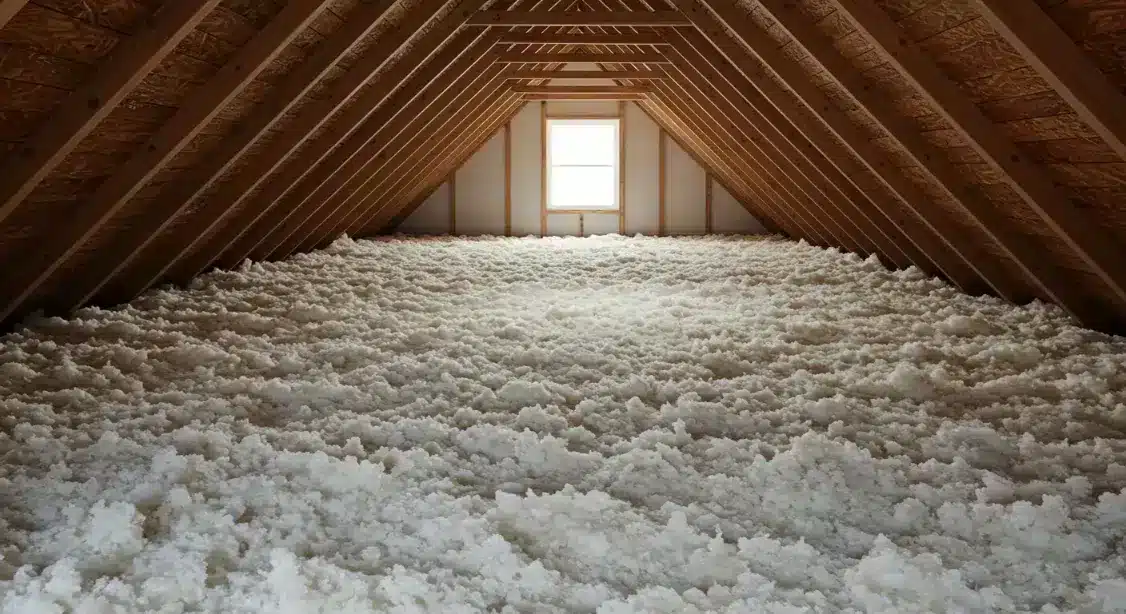
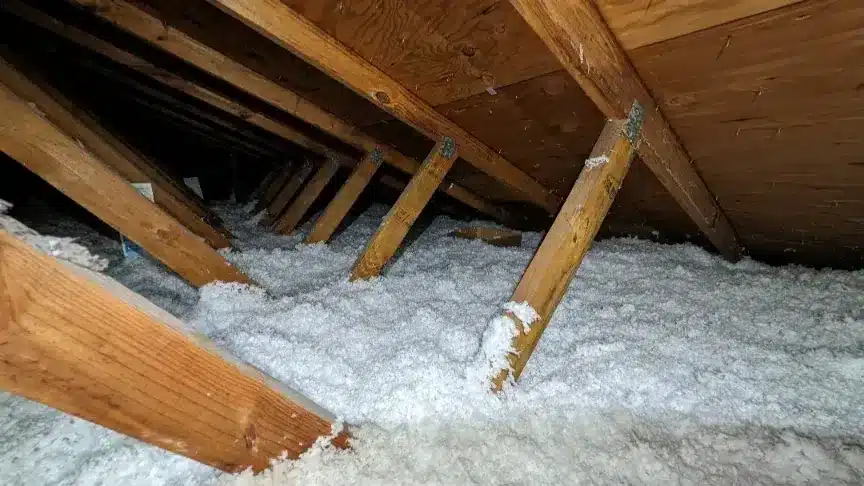
Loose-fill insulation is manufactured as small particles, blown through a hose into attics, finished wall cavities, and hard-to-reach areas. Because the material moves as millions of individual pieces, it conforms to each space and fills the irregular voids that force batts into seams and gaps. Check our local ratings on Google to see how local customers rate our work. Key performance differences include:
- Continuous contact. Particles settle into gaps around wiring, joists, and fittings instead of leaving air pockets.
- Better cavity fill. Loose fill fills wall cavities better than batts, and wet-spray applications seal even more effectively.
- Airflow resistance. Cellulose is denser and more resistant to air movement than loose fiberglass, and dense-packed cellulose is highly resistant to air infiltration.
- Upgrade compatibility. Adding a loose-fill layer on top of existing batts reduces air infiltration through the assembly.
Cellulose loose-fill delivers an R-value of roughly 3.4 to 3.8 per inch, carries a Class I fire safety rating, and contains no formaldehyde-based binders (Wikipedia – Building insulation material).
Blown-In vs. Traditional Batts at a Glance
| Factor | Blown-In Loose-Fill | Traditional Batts |
|---|---|---|
| Fit around wiring, ducts, framing | Conforms naturally, no cuts required | Must be cut and fitted by hand |
| Seams and bypasses | None within the fill; continuous blanket | Seams at every butt joint and cut edge |
| Air infiltration resistance | Dense-pack options block most air movement | Gaps become air leakage and condensation sites |
| Finished-wall retrofits | Blown through small drilled holes, no drywall removal | Requires opening the wall |
| Installation skill sensitivity | Density and depth must be verified | Fit quality varies with every installer decision |
| Settling | Expect up to 20% volume loss in dry-spray, priced into ratings | Minimal settling, but performance drops when compressed |
Why Gap-Filling Matters So Much in Gonzalez’s Climate
Escambia County sits in IECC Climate Zone 2, which carries a prescriptive ceiling insulation requirement of R-38 under the 2015 IECC Alliance to Save Energy – IECC Compliance Guide for Florida. ENERGY STAR recommends R-49 attic insulation for Zone 2 attics that are uninsulated and R-38 when you already have 3 to 4 inches of material in place ENERGY STAR – Recommended Home Insulation R-Values.
Gaps undermine those targets faster here than in milder regions:
- Humid infiltration is expensive. When refrigerative air conditioning runs in a hot, humid climate, sealing the envelope becomes especially important because dehumidifying infiltrated air wastes significant energy (Wikipedia – Building insulation).
- Radiant heat exploits openings. Summer sun drives roof temperatures high, and every void in the attic floor lets that heat radiate into living space.
- Moisture changes behavior. Elevated humidity raises the thermal conductivity of many insulating materials, so wet spots insulate worse than dry ones.
EPA climate-zone modeling puts the savings from air sealing plus insulation at 9% of heating and cooling costs in Zone 2, on top of the comfort gains from eliminating hot rooms and drafting ceilings (ENERGY STAR).
Where Blown-In Delivers the Biggest Wins
- Open attic floors. The most common application. Loose-fill blankets the joist field evenly and flows around every obstruction without seams.
- Finished wall cavities. Dense-pack retrofit fills enclosed walls through small drilled holes, ideal for rooms that never stay comfortable.
- Topping up older batts. A blown layer over compressed or gapped batts reduces the air infiltration those batts allow on their own.
Common Pitfalls, and How to Avoid Them
- Fluffing. Some installers use fewer bags than required for a stated R-value. Bag counts should match the manufacturer’s coverage chart, as required under the FTC’s R-Value Rule (16 CFR Part 460) (Wikipedia – Building insulation material).
- Unplanned settling. Dry-spray loose-fill can settle up to 20% of its original volume, so install depth must account for expected settling.
- Skipping air sealing. Blowing insulation over open penetrations buries leaks instead of fixing them. Seal first, then insulate.
- Uncontrolled moisture. Persistent roof or ventilation leaks degrade any insulation, so our team checks moisture sources before we recommend coverage.
Recommendations by Project Type
| Home Situation | Recommended Approach | Key Notes | Expected Outcome |
|---|---|---|---|
| Attic with 3-4 inches of old insulation | Blow additional loose-fill to R-38 | Verify bag count and settled depth | Reduced air leakage over existing batts |
| Uninsulated attic | Blow loose-fill to R-49 | Seal penetrations before installation | Meets ENERGY STAR Zone 2 guidance |
| Hot or cold finished rooms | Dense-pack wall retrofit | Fills cavities through small holes | More stable interior temperatures |
| Pre-drywall new construction or remodels | Wet-spray application | Allow walls to dry before closing | Tighter cavity fill than dry methods |
Signs You’ve Found the Right Approach
- The crew seals air leaks and documents bag counts before blowing anything.
- Depth rulers or markers are installed so you can verify coverage at any time.
- The quote states a target R-value and settled density in writing.
- Photos of the finished attic are provided, not just a summary invoice.
- Recommendations account for Gonzalez’s Zone 2 climate instead of a generic national standard.
Get a Gap-Free Attic in Gonzalez, FL
At Prestige Insulation Solutions LLC, we install blown-in insulation across Gonzalez, FL and the greater Pensacola area, and we measure every job against manufacturer coverage charts and Zone 2 R-value targets. Our team seals the air leaks first, documents depth and density, and treats your attic like it affects every room below it, because it does. Call us at (850) 429-4969 or email [email protected] to get started.
FAQs
Does blown-in insulation really fill gaps better than batts?
Yes. Loose-fill conforms to cavities and flows around obstructions, while batts must be cut to fit and leave seams and bypasses at every obstruction. Independent references note that loose-fill fills wall cavities better than batts.
Can blown-in insulation go over existing batts?
Yes. Layering loose-fill on top of old batts is a common retrofit and reduces the air infiltration batts allow on their own. We verify existing depth first so the combined assembly reaches your target R-value.
Will loose-fill settle and lose R-value over time?
Dry-spray loose-fill can settle up to 20% of its original volume, but published R-values for quality installations account for expected settling. Correct bag counts and installed density are what protect your rated performance.
What R-value should a Gonzalez, FL attic have?
Escambia County is in IECC Climate Zone 2, where the prescriptive ceiling target is R-38. ENERGY STAR recommends R-49 for uninsulated Zone 2 attics and R-38 when topping up an existing 3 to 4 inches.
How long does a typical blown-in installation take?
Most single-home attic projects are completed in a single visit. Dense-pack wall retrofits take a little longer because each cavity is filled and verified individually.
Sources
- ENERGY STAR – Methodology for Estimated Energy Savings – EPA modeling showing 15% average savings on heating and cooling from air sealing and attic insulation, including climate zone 2 results and typical home assumptions.
- ENERGY STAR – Rule Your Attic! For Comfort and Savings – EPA guidance on attic insulation benefits, comfort improvements, and available federal tax credits up to $1,200.
- Wikipedia – Building insulation material – Detailed reference on loose-fill versus batt performance, cellulose R-values, bypasses, settling, dense-pack applications, and the FTC R-Value Rule.
- Alliance to Save Energy – IECC Compliance Guide for Homes in Florida – Climate zone mapping placing Escambia County in Zone 2 with R-38 prescriptive ceiling insulation requirements.

- What Types of Insulation Can Be Professionally Removed From Your Home Safely and Efficiently in Pensacola, FL? - October 16, 2026
- What Should You Know Before Hiring Professional Insulation Removal Services in Pensacola, FL? - October 13, 2026
- Everything You Need to Know About Professional Insulation Removal - October 7, 2026